In this article
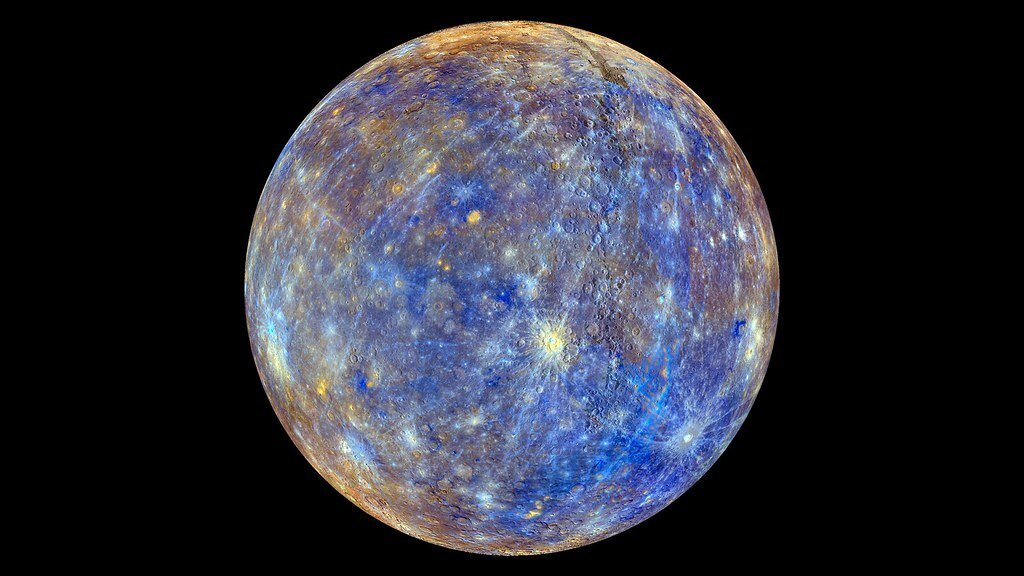
Yes, there is ice on Mercury, even though it is the planet closest to the Sun. The ice sits at the bottom of deep craters near its north and south poles, in places that sunlight never reaches. NASA’s MESSENGER spacecraft confirmed it in 2012, and a European mission arriving in December 2026 will take a closer look.
Key facts
- Daytime on Mercury can reach 430°C (800°F); at night it falls to about -180°C (-290°F), according to NASA.
- The ice is in permanent shadow: Mercury’s axis barely tilts, so some polar crater floors never see the Sun.
- First hint, 1991: the Arecibo radio telescope spotted radar-bright patches at the poles.
- Confirmed, 2012: MESSENGER found hydrogen and reflectance signals that matched water ice.
How can there be ice on Mercury?
It sounds impossible. According to NASA, Mercury’s surface can reach 800°F (430°C) by day. But the planet has almost no atmosphere to hold that heat, so temperatures crash at night. More importantly, Mercury barely tilts. The Johns Hopkins Applied Physics Laboratory (APL), which ran MESSENGER, puts the tilt of its axis at less than one degree, and NASA’s fact page gives about 2 degrees relative to its orbit. Either way, it is tiny compared with Earth’s 23 degrees.
On Earth, the bigger tilt means almost every place gets some sunlight during the year. On Mercury, the floors of deep craters near the poles stay in shadow forever. With no air to carry heat in, those shadows stay cold enough to keep ice frozen for very long periods.
How scientists found it
| Year | What happened |
|---|---|
| 1970s | NASA’s Mariner 10 maps less than half of Mercury |
| 1991 | The Arecibo radio telescope finds unusually radar-bright patches at Mercury’s poles, as ice would produce |
| 2004 | NASA launches MESSENGER |
| 2011 | MESSENGER becomes the first spacecraft to orbit Mercury |
| 2011 to 2012 | MESSENGER images show every radar-bright spot lies inside shadowed areas |
| 2012 | Three studies using MESSENGER data support water ice as the main ingredient |
| 2015 | MESSENGER runs out of fuel and crashes into Mercury |
| Dec 2026 | ESA and Japan’s BepiColombo is due to arrive at Mercury |
The three clues that confirmed the ice
In November 2012, APL announced that three independent lines of evidence supported water ice in Mercury’s polar craters:
- Hydrogen: MESSENGER’s neutron spectrometer measured extra hydrogen at the north pole. Lead author David Lawrence said the buried layer has a hydrogen content “consistent with nearly pure water ice”.
- Reflections: the Mercury Laser Altimeter, which fired more than 10 million laser pulses, found bright and dark patches in the shadowed areas that matched the radar spots.
- Temperature maps: models built from MESSENGER’s height measurements showed the radar-bright areas are exactly where ice would stay stable.
NASA’s MESSENGER mission page sums it up: the mission “verified its polar deposits are dominantly water-ice”. Principal investigator Sean Solomon put it more vividly: after more than 20 years of debate, MESSENGER “supplied a unanimous affirmative verdict”.
Why some of the ice is hidden under a dark layer
The ice is not always on show. In the coldest spots it is exposed at the surface. But across most of the deposits it lies under a thin dark layer, about 10 to 20 centimetres thick, where it is slightly too warm for bare ice to last.
Scientist David Paige of UCLA suggested this dark material is a mix of complex organic compounds, carbon-rich chemicals, delivered by comets and asteroids. Those same impacts probably brought the water itself. Radiation may have darkened the material further.
Mercury’s extremes at a glance
| Measure | Mercury | Why it matters for ice |
|---|---|---|
| Daytime high | 430°C (800°F) | Ice in sunlight would vanish quickly |
| Night-time low | -180°C (-290°F) | No atmosphere holds heat |
| Axis tilt | About 2 degrees or less | Polar crater floors stay in permanent shadow |
| Year | 88 Earth days | Fast orbit, but no seasons to warm the poles |
| Solar day | 176 Earth days | Long days and nights deepen the extremes |
Is Mercury the hottest planet?
No. As NASA notes, that title goes to Venus, whose thick atmosphere traps heat. Mercury is the closest planet to the Sun, but without an atmosphere it cannot hold onto its warmth.
What BepiColombo will look for
The joint European and Japanese mission BepiColombo launched in 2018 and is due to arrive at Mercury in December 2026, with routine science starting in April 2027. The European Space Agency lists the polar ice among its main questions: “Why is there ice in the polar craters of the scorched planet?” Its two orbiters should give the most detailed look yet at the deposits and the dark material around them.
For more on how we know the make-up of distant worlds, read how scientists proved atoms exist and how scientists know the age of the universe. And for how the elements are organised, see why the periodic table has that odd shape.
Frequently asked questions
Is there ice on Mercury?
Yes. Water ice sits in permanently shadowed craters near Mercury’s north and south poles, confirmed by NASA’s MESSENGER spacecraft in 2012.
Why doesn’t the ice on Mercury melt?
Mercury barely tilts, so the floors of some polar craters never see sunlight. With almost no atmosphere to carry heat, they stay cold enough for ice to survive.
Where did Mercury’s water come from?
Scientists think comets and water-rich asteroids delivered it when they crashed into the planet.
When does BepiColombo arrive at Mercury?
ESA says arrival is due in December 2026, with routine science operations from April 2027.
Browse more in our Astronomy section.