
In this article
Who enforces international law? No single body does. There is no world police force or global government. Instead, enforcement is shared between the UN Security Council, international courts, individual countries and economic pressure. It works when the powerful countries agree, or when obeying is in a state’s interest, and it fails when a permanent member of the Security Council objects. The eight cases below show the pattern.
Key facts
- UN Security Council: the only body that can legally order sanctions or military force for all UN members (Charter Articles 25, 41 and 42).
- The veto: any of the five permanent members can block that action (Article 27).
- Courts: the ICJ settles disputes between states; the ICC tries individuals but has no police and relies on states to arrest suspects.
- The ICTY indicted 161 people and sentenced 93, showing courts can deliver when states cooperate.
Who enforces international law: the main enforcers
The UN Security Council
Under the UN Charter, members “agree to accept and carry out the decisions of the Security Council” (Article 25). The Council can order measures short of force, such as sanctions (Article 41), and, if those fail, authorise military action (Article 42). But substantive decisions need nine votes including the “concurring votes of the permanent members” (Article 27), so China, France, Russia, the UK and the US can each veto. Our explainer on how the UN Security Council makes decisions covers the voting in detail.
International courts
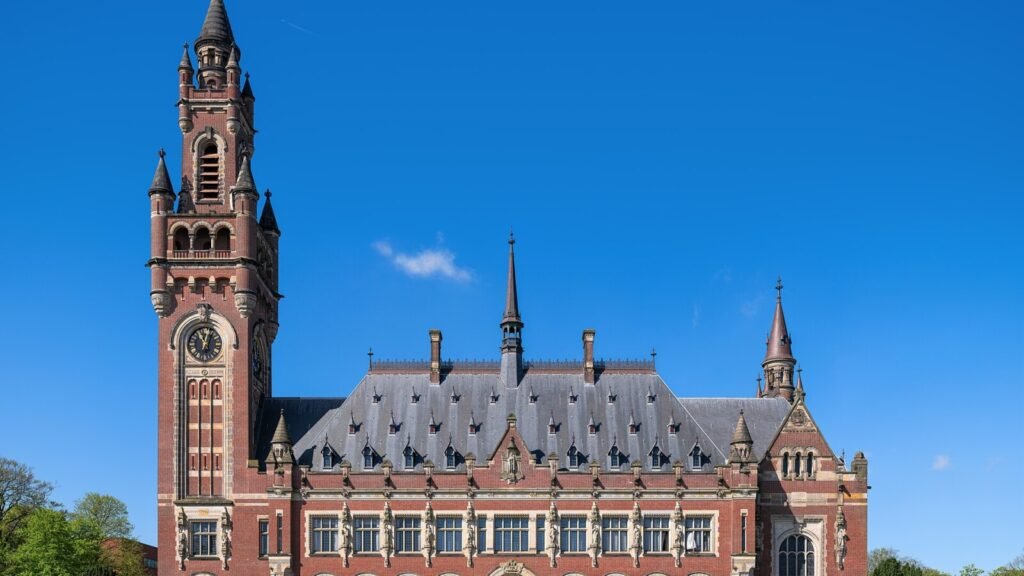
The International Court of Justice (ICJ) in The Hague settles legal disputes between states that accept its jurisdiction. Under Article 94 of the Charter, members undertake to comply with its rulings, and if one side refuses, the other can turn to the Security Council. The International Criminal Court (ICC) tries individuals for genocide, war crimes and crimes against humanity, but it has no police force: it depends on member states to arrest and hand over suspects.
States and pressure
Much enforcement is decentralised. Countries impose their own sanctions, cut trade, expel diplomats, or take cases to tribunals. Reputation matters too: states that ignore rulings find it harder to make deals. Most international law, on trade, aviation, post or the sea, is obeyed most of the time because breaking it costs more than following it.
8 cases: when enforcement worked and when it failed
| Case | Enforcer | Outcome |
|---|---|---|
| Iraq invades Kuwait (1990) | Security Council Resolution 678 authorised force | Worked: Iraqi forces expelled in 1991 |
| Nicaragua v. United States (1986) | ICJ judgment | Failed: the US rejected the ruling and could veto Council action |
| Bakassi Peninsula (2002 ruling) | ICJ, then a UN-brokered deal | Worked: Nigeria handed control to Cameroon in 2006 |
| Former Yugoslavia (1993 to 2017) | UN tribunal (ICTY) | Largely worked: 161 indicted, 93 sentenced |
| South China Sea arbitration (2016) | Arbitral tribunal | Failed: China rejected the award |
| WTO trade disputes (since 2019) | WTO Appellate Body | Stalled: appeals cannot be heard since members’ terms expired |
| Putin arrest warrant (2023) | ICC | Not enforced: Mongolia did not arrest him in 2024 |
| Rodrigo Duterte (2025) | ICC with Philippine cooperation | Worked: taken into ICC custody in March 2025 |
What the cases show
When Iraq invaded Kuwait, the permanent members agreed, and Resolution 678 of November 1990 authorised “all necessary means”. In Nicaragua v. United States, the ICJ ruled in June 1986 that the US had broken international law by supporting armed groups against Nicaragua. The US refused to take part in the merits phase, and as a permanent member it could block Security Council enforcement.
Courts work best when both sides want a settlement. The ICJ’s Cameroon v. Nigeria judgment of 10 October 2002 placed the Bakassi Peninsula in Cameroon. Under the UN-brokered Greentree Agreement, Nigeria formally handed over control in August 2006. The Yugoslavia tribunal succeeded because states eventually arrested suspects; of 161 people indicted, 93 were sentenced and 18 acquitted.
Criminal courts stall when governments protect the accused. The ICC issued a warrant for Vladimir Putin on 17 March 2023 over the alleged unlawful deportation of children from Ukraine. When he visited Mongolia, an ICC member, in September 2024, he was not arrested, and ICC judges later found Mongolia had failed to cooperate. By contrast, after the Philippines arrested former president Rodrigo Duterte, he was taken into ICC custody on 12 March 2025.
Even trade law can freeze. The WTO says its Appellate Body cannot hear appeals because of vacancies, and the last member’s term expired on 30 November 2020. That means a country that loses a panel ruling can appeal and leave the case unresolved.
So is international law real law?
Yes, but enforcement is political rather than automatic. The best predictor of whether a rule is enforced is whether the most powerful states support it. Borders drawn long ago still shape many disputes, as our report on colonial borders and conflict explains.
Please note: This article explains how international law works in general. It is not legal advice.
Frequently asked questions
Who enforces international law?
No single body. The UN Security Council can order sanctions or force, courts such as the ICJ and ICC issue rulings, and states enforce through sanctions, trade and arrests.
Can international law be enforced?
Yes, when states cooperate: Iraq’s expulsion from Kuwait and the Yugoslavia tribunal’s 93 sentences are examples. It fails when a permanent Council member or a protecting state objects.
How is international humanitarian law enforced?
Mainly by states prosecuting war crimes in their own courts, and by international courts such as the ICC and past UN tribunals when national courts do not act.
Which country enforces international law?
None alone. Enforcement depends on the Security Council’s five permanent members and other states choosing to act.
Read more in our International Relations section.


