In this article
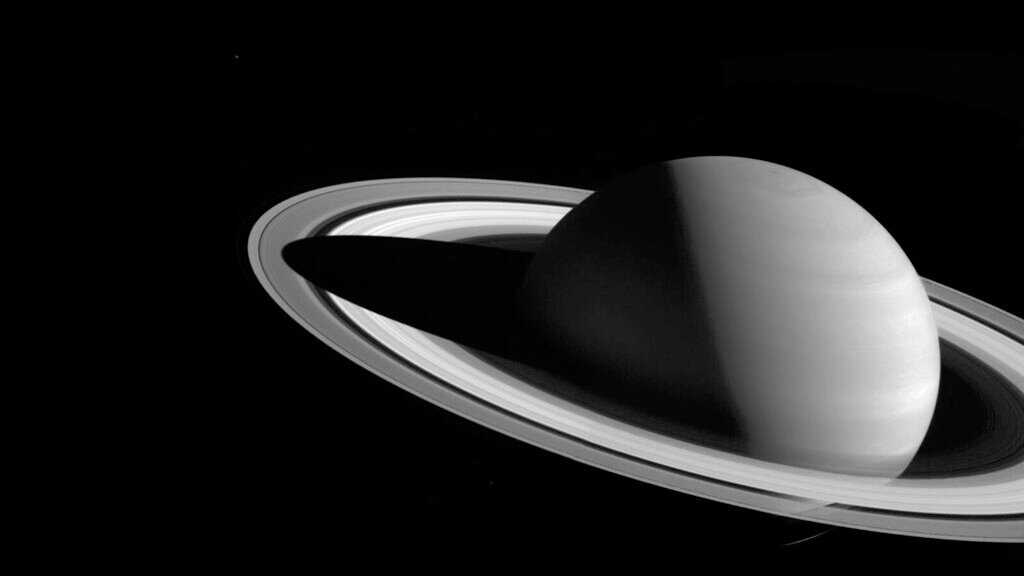
How old are Saturn’s rings? The best measurements from NASA’s Cassini spacecraft suggest they are young: somewhere between 10 million and 400 million years old, far younger than Saturn itself, which formed about 4.5 billion years ago. But the question is not settled. A 2024 study argued that the rings may only look young, and could be as old as the planet. Here is the evidence on both sides.
Key facts
- 10 to 100 million years: the age implied by Cassini’s 2019 ring mass measurement (Iess and colleagues).
- No more than 400 million years: the 2023 estimate from dust Cassini collected (Kempf and colleagues).
- About 4.5 billion years: the age of Saturn, according to NASA.
- About 10 metres thick in the main rings, though they stretch up to 282,000 km from the planet.
Why ring age is so hard to measure
You cannot carbon-date ice in space. Instead, scientists use a clock based on dirt. The rings are mostly water ice, and dark dust from space, called micrometeoroids, falls on them all the time. Physicist Sascha Kempf compares the rings to the carpet in your house: the dirtier it is, the longer it has been down. Saturn’s rings are strikingly clean and bright, which points to a young age, if the clock works the way scientists assume.
How old are Saturn’s rings? The evidence, side by side
| Study | Method | What it found | Age it implies |
|---|---|---|---|
| Iess et al., 2019 (Cassini Grand Finale) | Measured the rings’ gravity pull on Cassini to get their mass | Rings are low in mass, so they would darken quickly | 10 to 100 million years |
| Kempf et al., 2023 | Counted dust grains from outside Saturn’s neighbourhood: 163 in 13 years | Dust falls slowly enough to date the rings’ cleanliness | No more than 400 million years |
| O’Donoghue et al., 2018 (“ring rain”) | Measured ring material falling into Saturn | Rings are losing mass fast | Consistent with a young, short-lived ring system |
| Hyodo et al., 2024 | Computer simulations of fast dust impacts on icy ring particles | Most impactor material vaporises and escapes instead of sticking | Could be as old as Saturn |
The case for young rings
In its final orbits, Cassini flew between Saturn and its rings. By tracking how gravity tugged the spacecraft, down to a fraction of a millimetre per second, scientists could separate the pull of the planet from the pull of the rings. NASA JPL reported that the low mass this revealed indicates the rings formed between 10 million and 100 million years ago.
Kempf’s team used Cassini’s Cosmic Dust Analyzer. Over 13 years it caught just 163 grains that came from beyond Saturn’s neighbourhood. Working out how much dust that means over time, they concluded the rings have been collecting it for no more than about 400 million years.
The case for old rings
In December 2024, Ryuki Hyodo and colleagues published a study in Nature Geoscience that challenged the dirt clock itself. Their simulations suggest that dust hitting ring particles at very high speed mostly vaporises. The vapour forms tiny charged particles that crash into Saturn, escape or are pulled away, instead of coating the ice. If that is right, clean rings do not have to be young, and they could date from Saturn’s early history.
This is a theoretical result based on simulations rather than new observations, so the debate is open. The disagreement is about how efficiently dust sticks to ring ice, which laboratory experiments can test.
Are Saturn’s rings disappearing?
Slowly, yes. Ring particles are pulled into Saturn by gravity and its magnetic field, a process called ring rain. A NASA-led study estimated the rate at about one Olympic-sized swimming pool of water every half hour, which, according to NASA Goddard, means the rings will be gone in under 300 million years. That does not settle their age, but it does mean we live at a lucky time to see them.
According to NASA’s Saturn facts page, the rings are thought to be pieces of comets, asteroids or shattered moons torn apart by Saturn’s gravity, ranging from dust-sized icy grains to chunks as big as a house.
Putting the numbers in scale
| Event | Years ago |
|---|---|
| Saturn forms | About 4.5 billion |
| Rings form, if the 2024 “old rings” idea is right | Up to about 4.5 billion |
| Rings form, upper limit from dust (2023) | About 400 million |
| Rings form, Cassini mass estimate (2019) | 10 to 100 million |
| Rings gone, ring rain estimate | Within 300 million years from now |
Gravity is behind both the rings’ origin and their slow loss; for gravity closer to home, see do heavier objects fall faster? For other deep-time puzzles, read how we know the age of the universe and why Mercury has ice.
Frequently asked questions
How old are Saturn’s rings?
Most Cassini-based estimates say 10 million to 400 million years, much younger than Saturn’s 4.5 billion years. A 2024 study argues they could be as old as the planet.
Are Saturn’s rings disappearing?
Yes, slowly. Ring rain is draining material into Saturn, and NASA scientists estimate the rings could be gone in under 300 million years.
What are Saturn’s rings made of?
Mostly water ice, in pieces from tiny grains to chunks as big as a house, probably from broken comets, asteroids or moons.
How thick are Saturn’s rings?
The main rings are typically only about 10 metres (30 feet) thick, even though they extend up to 282,000 km from Saturn.
Read more in our Astronomy section.
Sources
- NASA JPL: NASA’s Cassini data show Saturn’s rings relatively new
- University of Colorado Boulder: How old are Saturn’s rings? Far younger than once thought
- Hyodo, Genda and Madeira (2024), Pollution resistance of Saturn’s ring particles during micrometeoroid impact, Nature Geoscience
- NASA Goddard Scientific Visualization Studio: Saturn’s rings are disappearing
- NASA Science: Saturn facts