In this article
Asking how old the universe is sounds like a question without an answer. In fact, astronomers have arrived at a figure of about 13.8 billion years, and several independent methods agree to within a few percent.
Key facts
- 13.8 billion years: the best estimate of the universe’s age, from the European Space Agency’s Planck mission.
- 380,000 years: the age of the universe when the oldest light we can see, the cosmic microwave background, was released.
- 280 million years after the Big Bang: when we see MoM-z14, the most distant galaxy confirmed so far, found by the James Webb Space Telescope.
- The Hubble tension: two ways of measuring the universe’s expansion rate still disagree, by about 67 versus 73 kilometers per second per megaparsec.
Prefer to watch? Our short video walks through the same evidence.
Clue 1: The universe is expanding
In the 1920s astronomers found that distant galaxies are moving away from us, and that the farther away they are, the faster they recede. This relationship, now called the Hubble-Lemaitre law, means space itself is expanding.
If everything is moving apart today, it was closer together in the past. Running the expansion backward points to a time when all the matter in the observable universe was packed into an extremely hot, dense state. That starting point is what we call the Big Bang. The rate of expansion, known as the Hubble constant, therefore gives a rough age.
Clue 2: The oldest light
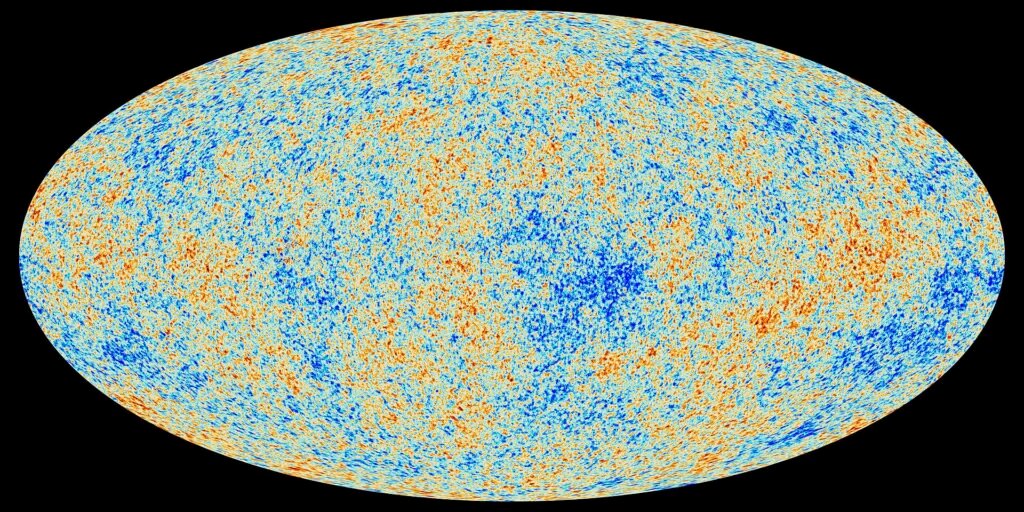
About 380,000 years after the Big Bang, the universe cooled enough for atoms to form and light to travel freely. That light still fills space as faint microwave radiation, the cosmic microwave background. The European Space Agency’s Planck satellite mapped it in great detail between 2009 and 2013. Its tiny temperature variations reveal the universe’s composition and geometry, from which scientists calculate an age of 13.787 billion years, with an uncertainty of about 20 million years.
Clue 3: The oldest stars
Stars change in predictable ways as they age. By studying clusters of very old stars in our galaxy, astronomers can estimate how long they have existed. The oldest are around 12 to 13 billion years old. That is younger than the universe, as it must be, which gives an independent check.
Clue 4: The earliest galaxies
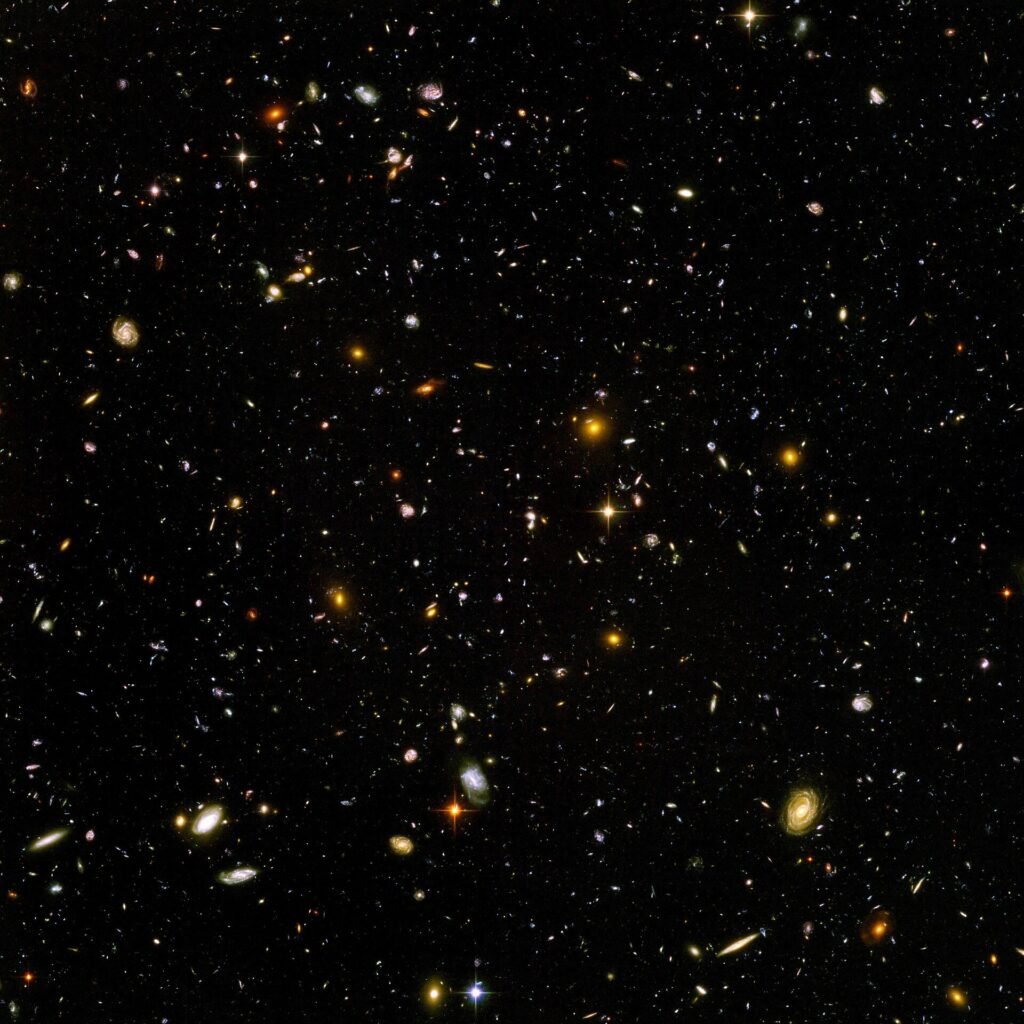
The James Webb Space Telescope, launched in 2021, can see galaxies whose light left them more than 13 billion years ago. In 2025 astronomers confirmed a galaxy called MoM-z14, seen as it was just 280 million years after the Big Bang, the most distant yet confirmed. It is brighter and more chemically developed than expected, which is helping scientists refine models of how quickly the first galaxies formed.
| Method | What it measures | Result |
|---|---|---|
| Expansion of the universe | How fast galaxies move apart | Consistent with about 13 to 14 billion years |
| Cosmic microwave background | The universe’s composition and geometry | 13.787 billion years (Planck) |
| Oldest star clusters | How long the oldest stars have existed | About 12 to 13 billion years, a lower limit |
| Most distant galaxies | How early galaxies formed | Galaxies within 300 million years of the start |
The puzzle: the Hubble tension
Scientists can measure the current expansion rate in two ways. Working forward from the cosmic microwave background gives about 67 to 68 kilometers per second per megaparsec. Measuring nearby galaxies directly, using stars called Cepheids and exploding stars called supernovae, gives about 73. A megaparsec is about 3.26 million light-years.
The gap is small but has survived years of checking, including new observations by Webb that ruled out several simple explanations. If it is real, it may point to something missing from our understanding of physics, such as the nature of dark energy. It does not change the broad picture of a universe roughly 13.8 billion years old, but it could adjust the details.
The Science Behind Weather Forecasts
Frequently asked questions
What was there before the Big Bang?
Nobody knows. Current physics describes the universe from a tiny fraction of a second after the Big Bang onward. Whether time had a beginning, or something came before, is still an open question.
If the universe is 13.8 billion years old, how can we see 46 billion light-years away?
Because space has kept expanding while light travelled. The most distant regions whose light reaches us are now much farther away than 13.8 billion light-years.
How do we know the Big Bang happened at all?
Three main pieces of evidence: the expansion of the universe, the cosmic microwave background, and the amounts of light elements such as hydrogen and helium, which match predictions of a hot early universe.
For more on how scientists observe our own planet, see why oceans matter to the climate and browse our Science section.