In this article
Fire a rifle and it kicks back into your shoulder. Jump off a small boat and the boat slides the other way. A rocket in empty space, with no air to push against, still speeds up. These look like three different puzzles. They are all the same rule.
Key facts
- Momentum = mass × velocity. A heavy, fast object has a lot of it; a light, slow one has little.
- The rule: if no outside force acts on a group of objects, their total momentum stays the same.
- Direction matters: momentum forward in one object must be balanced by momentum backward in another.
- Rockets need nothing to push against: they push on their own exhaust, which is why they work in space.
What momentum means
Momentum is a measure of how hard it is to stop something. A truck rolling slowly can have more momentum than a fast bicycle, because it is so much heavier. Scientists write it as p = m × v, where m is mass in kilograms and v is velocity in metres per second.
The key rule, called the conservation of momentum, says that inside a closed system the total momentum does not change. A closed system just means no outside push or pull is acting, or that outside forces are small enough to ignore for a moment. It follows from Newton’s third law: when two objects push on each other, the forces are equal and opposite, so whatever one gains, the other loses.
1. A rifle’s recoil
Before firing, the rifle and the bullet are still, so their total momentum is zero. After firing, the bullet flies forward. For the total to stay zero, the rifle must move backward.
| Mass | Speed | Momentum | |
|---|---|---|---|
| Bullet | 0.01 kg (10 g) | 900 m/s forward | 9 kg·m/s forward |
| Rifle | 4 kg | 2.25 m/s backward | 9 kg·m/s backward |
The rifle moves far slower than the bullet because it is 400 times heavier. Holding it tight against your shoulder helps, because now your body moves with the rifle. With an 80 kg person added, the backward speed drops to about 0.1 m/s, a firm push instead of a painful kick.
2. A rocket in space
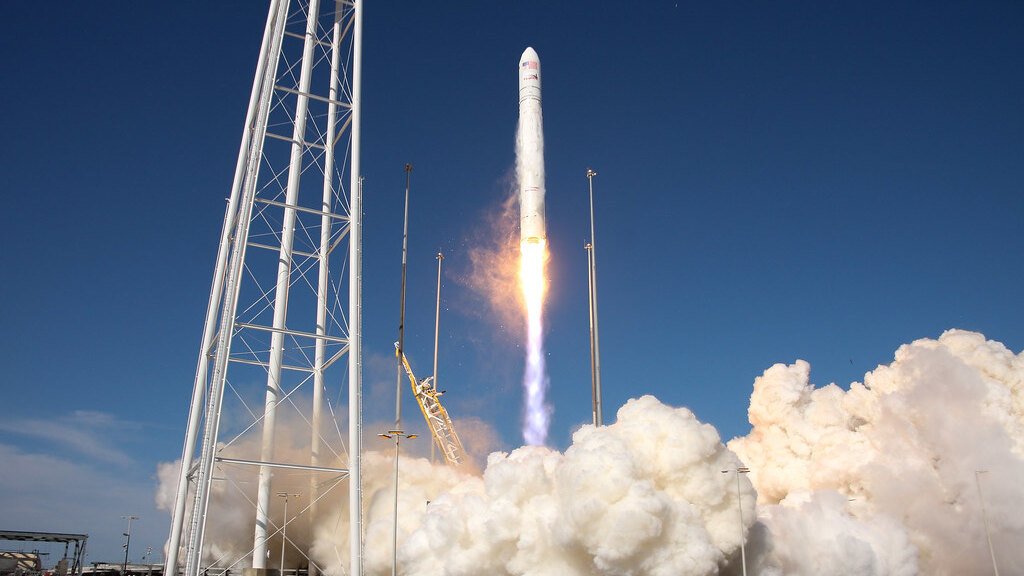
A common myth says rockets need air to push against. They do not. A rocket engine throws hot gas out of the back at very high speed. That gas carries momentum backward, so the rocket gains the same amount forward. NASA explains that thrust comes from this exchange, which works just as well in a vacuum.
In fact rockets work slightly better in space, because there is no air pressure at the nozzle and no air resistance slowing them down.
3. Jumping off a boat
Suppose a 60 kg person jumps forward off a 120 kg rowing boat at 3 m/s. The person carries 180 kg·m/s forward, so the boat must take 180 kg·m/s backward. That gives the boat a speed of 1.5 m/s away from the dock, which is why people sometimes end up in the water.
4. Two skaters pushing apart
Two ice skaters stand still, then push each other’s hands. A 50 kg skater glides away at 3 m/s. The 75 kg skater moves the other way at 2 m/s. Both carry 150 kg·m/s, in opposite directions, so the total is still zero. Ice is useful here because it has very little friction, so the system is close to closed.
5. A car crash
A 1,500 kg car at 20 m/s (72 km/h) hits a stopped 1,000 kg car, and the two lock together. Before the crash, the total momentum is 30,000 kg·m/s. Afterwards, the combined 2,500 kg wreck must carry the same momentum, so it moves at 12 m/s. Crash investigators use exactly this kind of calculation, working backward from where the cars ended up.
Momentum is conserved in the crash, but energy of motion is not: much of it turns into heat, noise and crushed metal. For more on energy, see our explainer on watts, joules and energy.
6. A fire hose pushing back
Firefighters have to brace themselves against a hose. Every second, the hose throws a large mass of water forward at high speed. The water gains forward momentum, so the hose and nozzle are pushed backward with a steady force. A garden hose does the same on a small scale.
Where people go wrong
- Forgetting direction. Momentum has a direction. Forward and backward amounts cancel out.
- Ignoring outside forces. Friction and gravity eventually slow things down. Conservation holds for the brief moment of a push or collision.
- Mixing up momentum and energy. Momentum is always conserved in a closed system. Kinetic energy, the energy of motion, often is not.
Frequently asked questions
Why doesn’t a gun recoil as fast as the bullet?
Because the gun is much heavier. The same amount of momentum spread over more mass gives a lower speed.
How do rockets move in space if there is nothing to push against?
They push against their own exhaust. Throwing gas backward gives the rocket equal momentum forward.
Is momentum ever not conserved?
Only when an outside force acts on the system, such as friction or a push from something outside it. Include that outside object and the total is conserved again.
Next, read about another motion that confuses people: whether centrifugal force is real. Or browse our Physics section.