
In this article
When headlines say a famous investor “bought” or “dumped” a stock, the information usually comes from a single public document: Form 13F. It is free, it is official, and anyone can read it. It is also widely misunderstood. Used carefully, it shows how large funds are positioned. Used carelessly, it can lead you to copy trades that were made months ago.
Key facts
- $100 million: managers with discretion over at least this much in qualifying US securities must file Form 13F.
- 45 days: the deadline after the end of each calendar quarter.
- Long positions only: short positions are not reported.
- Free: every filing is public on the SEC’s EDGAR database.
What Form 13F is
Under Section 13(f) of the Securities Exchange Act, any institutional investment manager that exercises investment discretion over $100 million or more in “Section 13(f) securities” must report its holdings to the U.S. Securities and Exchange Commission every quarter. That includes hedge funds, mutual fund companies, pension managers, banks and insurers, and foreign managers who invest in US markets. The rules are explained in the SEC’s Form 13F questions and answers.
Section 13(f) securities are mainly US-listed stocks, shares of exchange-traded funds and closed-end funds, plus certain options and convertible bonds. The SEC publishes the official list every quarter.
The 45-day delay, and why it matters
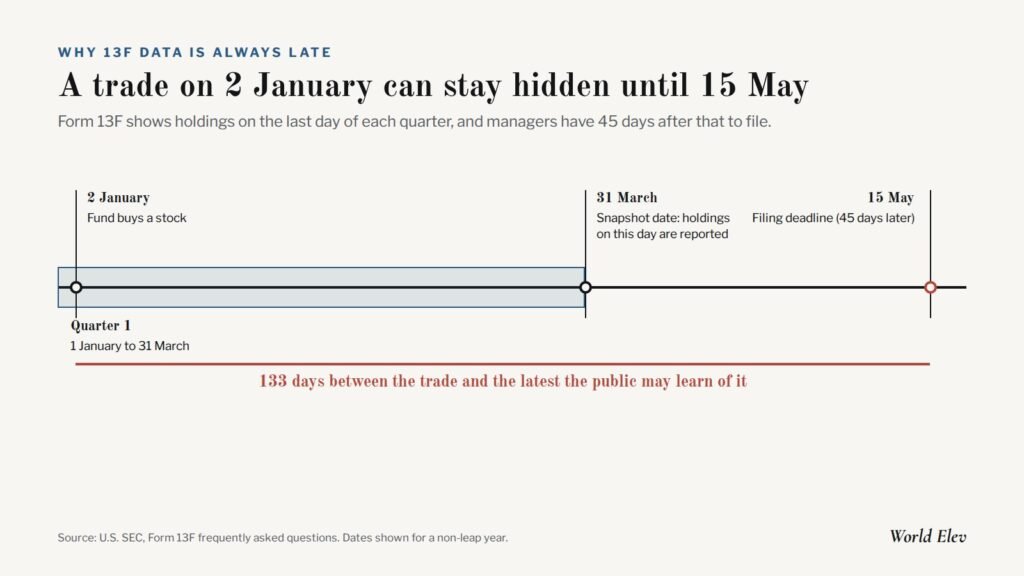
A 13F shows what a manager held on the last day of the quarter, and it can be filed up to 45 days later. A stock bought on 2 January may therefore stay out of public view until mid-May, more than four months later. By the time you read the filing, the manager may already have sold.
How to find a filing
- Go to the SEC’s EDGAR full-text search.
- Type the manager’s name, for example a well-known fund company, and select it from the list of entities.
- Filter by form type 13F-HR (the holdings report). 13F-HR/A is an amendment; 13F-NT means the holdings are reported by another manager.
- Open the filing and choose the information table. This is the list of holdings.
Reading the information table, column by column
| Column | What it means | What to watch for |
|---|---|---|
| Name of issuer | The company | Several share classes may appear separately |
| Title of class | Type of security, such as common stock or a call option | “CALL” or “PUT” lines are options, not shares |
| CUSIP | A unique nine-character code for the security | Use it to match lines across quarters |
| Value | Market value at quarter end | Value, not cost; it changes with the price even if no shares were traded |
| Shares or principal amount | Number of shares held | Compare shares, not value, to see real buying or selling |
| Put/Call | Marks option positions | Options show the underlying shares, not the money at risk |
| Investment discretion | Sole, shared or defined | Shared lines can repeat across related managers |
| Voting authority | How many shares the manager can vote | Not a sign of conviction |
A worked example: did the fund really buy more?
Suppose a fund reports the same company in two quarters.
| Quarter end | Shares | Price | Reported value |
|---|---|---|---|
| 31 March | 1,000,000 | $80 | $80 million |
| 30 June | 1,000,000 | $100 | $100 million |
The value rose by $20 million, but the share count did not change. The fund bought nothing; the price simply went up. Many “fund buys more” stories confuse the two. Always compare share counts between quarters, and work out each holding’s share of the total portfolio by dividing its value by the sum of all values in the table.
What a 13F does not show
- Short positions. A fund can look heavily invested in a stock while betting against it elsewhere.
- Most non-US holdings. Shares traded only on foreign exchanges are not on the list.
- Bonds, cash and mutual fund shares. Open-end mutual funds are explicitly excluded.
- Trades within the quarter. A stock bought in February and sold in March never appears.
- Some positions, for a while. Managers can ask the SEC to keep a holding confidential, for example while they are still building it.
Faster signals: Forms 13D, 13G and 4
If you want more timely information, two other filings help. An investor who acquires more than 5 percent of a company must file Schedule 13D or 13G; after rule changes the SEC adopted in October 2023, an activist investor’s initial 13D is due within five business days. Company insiders, such as directors and senior officers, must report their own trades on Form 4, usually within two business days.
How to use 13F data sensibly
- Treat it as a record of where a fund stood, not a list of trade ideas.
- Look at changes over several quarters, not one.
- Remember that big managers run many strategies, so one filing can mix very different bets.
- Check the company’s own reports before acting on anything.
Important: This article explains a public document. It is not investment advice, and copying a fund’s holdings carries the same risks as any other investment.
Frequently asked questions
When are 13F filings released?
Within 45 days after the end of each quarter: by about 15 May, 14 August, 14 November and 14 February. Many managers file in the last few days before the deadline.
Do 13F filings cost anything to read?
No. All filings are free on the SEC’s EDGAR system. Paid websites only repackage the same data.
Why can’t I find a fund I’ve heard of?
It may manage less than $100 million in qualifying securities, invest mainly outside the US, or report under a parent company’s name.
For context on what you are looking at, read how to read a company’s annual report and why the Dow and the S&P 500 can move in opposite directions, or browse the Stocks section.