In this article
The Byzantine Empire is often treated as a footnote between ancient Rome and the Renaissance. Its people never used the word “Byzantine”; they called themselves Romans. For more than a thousand years, from its capital Constantinople, now Istanbul, it ruled the eastern Mediterranean until the city fell to the Ottomans in 1453.
Much of what it built is still with us, often in places people do not expect.
Key facts
- 529 to 534: Emperor Justinian’s lawyers compiled the Corpus Juris Civilis, the foundation of the legal systems used across much of the world today.
- 537: Hagia Sophia was completed, using pendentives to set a huge round dome on a square base.
- About 700 years: how long the Byzantine gold coin, the solidus, served as a currency standard.
- Cyrillic: the alphabet used for Russian, Ukrainian, Bulgarian and Serbian grew out of a Byzantine mission in the 9th century.
1. The law code behind modern legal systems
Roman law had piled up over centuries into a confusing mass. Between 529 and 534, Emperor Justinian had his officials gather it, cut it down and organise it into one collection, later called the Corpus Juris Civilis, or “Body of Civil Law”.
The code was largely forgotten in Western Europe for centuries. Around 1100, scholars in Bologna, Italy, began studying it again, and it became the basis of university legal training. From there it shaped the “civil law” tradition now used in most of continental Europe, Latin America and many other countries. Ideas such as written contracts, property rights and the rules of inheritance in these systems trace back to Justinian’s books.
2. How to put a giant dome on a square building
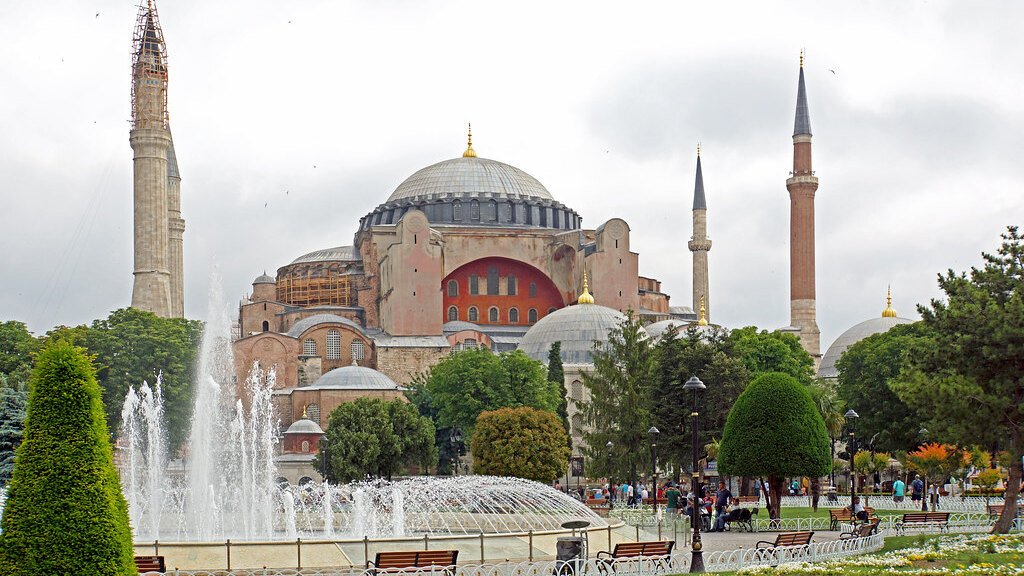
Justinian also rebuilt the great church of Hagia Sophia, finished in 537. Its architects faced a hard problem: how do you rest a round dome on a square space without filling the floor with columns?
Their answer was the pendentive, a curved triangle of masonry that fills each corner between four great arches. Together, the four pendentives turn the square into a circle at the top, so the dome’s weight runs down into the corner supports. The result was a vast open interior that amazed visitors.
The idea spread widely. Later churches across the Orthodox world, St Mark’s Basilica in Venice and the great Ottoman mosques of Istanbul all use domes on pendentives. Hagia Sophia is part of the Historic Areas of Istanbul World Heritage Site.
3. A coin people trusted for centuries
The Byzantine gold coin, the solidus, also called the nomisma, was introduced by Constantine I in the 4th century. According to the World History Encyclopedia, it remained the currency standard for about 700 years, until it was replaced by a new coin in the 12th century.
For most of that time its weight and gold content changed very little. Merchants far beyond the empire accepted it, which made it something like an international currency. It is an early example of a lesson central banks still repeat: money works best when people trust it will keep its value.
4. An alphabet for millions
In the 9th century the Byzantine church sent two brothers, Cyril and Methodius, to spread Christianity among Slavic peoples. They created a new alphabet so the Bible could be written in the Slavic language. The Cyrillic alphabet, named after Cyril, developed soon afterwards and drew heavily on Greek letters.
Today Cyrillic is the official script for languages including Russian, Ukrainian, Bulgarian, Serbian and Macedonian.
5. The books that saved ancient Greek learning
Byzantine scholars and monks kept copying the works of ancient Greek writers, including Homer, Plato, Aristotle and Euclid, long after many were lost in the West. As the empire weakened in the 1400s, Greek scholars moved to Italy, bringing manuscripts and teaching Greek. One of them, Cardinal Bessarion, gave his large library to Venice, where it became the core of the Marciana Library.
This flow of books and teachers helped feed the Italian Renaissance. Many ancient Greek texts we read today survive because Byzantine copyists preserved them.
| Byzantine idea | Where you meet it today |
|---|---|
| Justinian’s law code | Civil law systems in Europe, Latin America and beyond |
| Dome on pendentives | Churches and mosques worldwide, including Istanbul and Venice |
| Stable gold coin | The idea of a trusted, stable currency |
| Cyrillic alphabet | Russian, Ukrainian, Bulgarian, Serbian and more |
| Copied Greek manuscripts | Many surviving texts of Plato, Aristotle and Homer |
What did not come from Byzantium
Some popular claims go too far. Modern banking grew mainly from medieval Italian merchant houses, not directly from Constantinople. And “Byzantine” as a word for needlessly complicated rules is a later Western insult, not a fair summary of how the empire ran for a thousand years.
For another case of ancient knowledge that still matters, read how the Maya predicted eclipses without telescopes.
Frequently asked questions
Why is it called the Byzantine Empire?
Western historians coined the name long after the empire ended, from Byzantium, the old Greek name of Constantinople. Its own people called themselves Romans.
What is the most important Byzantine legacy?
Many historians point to Justinian’s law code, because it shaped the civil law systems used in much of the world.
Is Hagia Sophia still standing?
Yes. It still stands in Istanbul and is part of a UNESCO World Heritage Site. It has served as a church, a mosque, a museum and again a mosque.
Browse more in our Empires section.