In this article
This GPTZero review is for teachers, students and editors deciding whether to trust or pay for GPTZero in 2026. GPTZero is one of the most widely used AI detectors, built mainly for education. It is clearer and better documented than many rivals, but no detector is accurate enough to decide whether someone cheated.
A serious, education-focused detector with clear pricing, a usable free plan and much better accuracy claims than early versions. Its weaknesses: scanned dashboard text is stored to improve the service, there is no refund policy in its terms, and user ratings are mixed.
- Best for
- Teachers and schools who want AI checks plus writing-process evidence
- Price
- Free; Premium $12.99 and Professional $24.99 a month billed annually
- Free use
- 10,000 words a month
- Accuracy claim
- Detects 95.7% of AI text with 1% false positives (its own RAID result)
- Refunds
- No refund policy in its terms; cancellation ends at the term’s end
- Company
- GPTZero Inc., New York; joining Superhuman (Grammarly’s parent)
How we reviewed: We did not accept payment for this review, and it contains no affiliate links. On 15 October 2026 we read GPTZero’s pricing page, terms of use (updated 21 August 2026), privacy policy (updated 2 April 2026), FAQ and its published accuracy claims, captured the pricing page, and checked Trustpilot and academic research. We tried to run the same four test texts we used in our ZeroGPT review, but GPTZero’s free scanner did not return a result in our automated browser, and we did not create an account. So the accuracy section relies on published tests.
What is GPTZero?
GPTZero is an AI detector founded in January 2023 by GPTZero Inc. It scores text at document, sentence and word level, and adds tools for teachers: a Chrome extension, writing replays that show how a document was typed, plagiarism checks and citation help. In June 2026 the company announced it plans to join Superhuman, the company behind Grammarly, and its site now says GPTZero “is now a part of Superhuman”. It says nothing changes for daily users.
GPTZero pricing in 2026
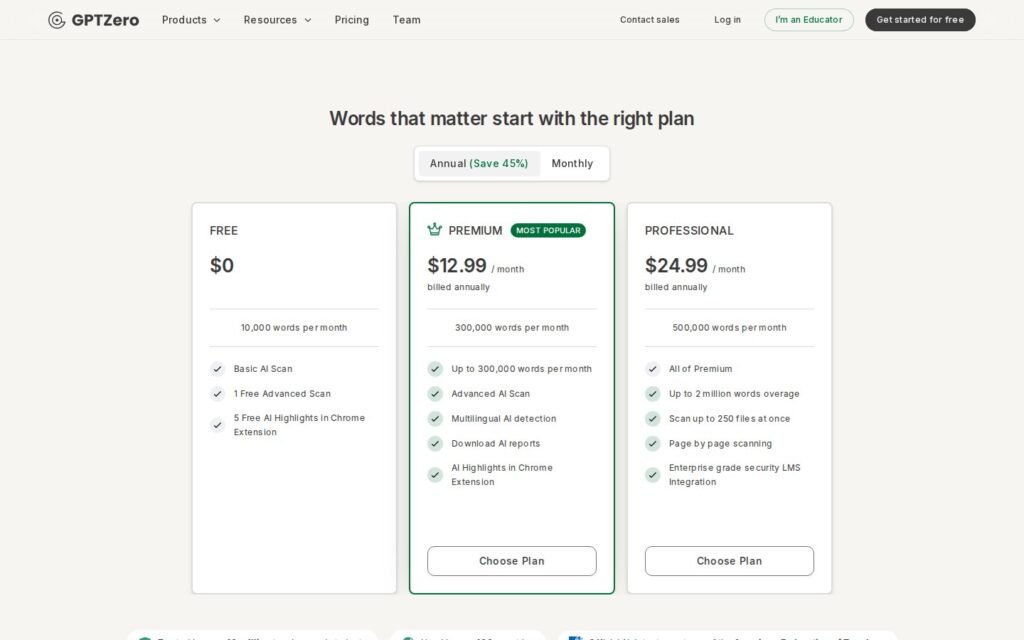
| Plan | Annual billing | Monthly billing | Words per month | Max per scan |
|---|---|---|---|---|
| Free | $0 | $0 | 10,000 | Basic scan, 1 free Advanced Scan |
| Premium | $12.99/mo ($155.88/yr) | $23.99/mo | 300,000 | 50,000 characters |
| Professional | $24.99/mo ($299.88/yr) | $45.99/mo | 500,000 (plus up to 2 million overage) | 150,000 characters |
Cost per essay
On Premium billed annually, 300,000 words for $12.99 works out to about 4.3 cents per 1,000 words, or roughly 6.5 cents for a 1,500-word essay. Paying monthly nearly doubles that, to about 12 cents an essay. Either way, Premium covers about 200 essays of that length a month. The free plan’s 10,000 words covers about six.
Is GPTZero accurate?
GPTZero’s homepage advertises “99% accuracy”. Its October 2025 post on the independent RAID benchmark, an academic test set published in 2024, is more specific: it says GPTZero detected 95.7% of AI texts while wrongly flagging 1% of human texts as AI. Those are strong figures, but they were published by GPTZero itself.
Early independent tests were far less flattering. In the peer-reviewed 2023 Weber-Wulff study, GPTZero scored 54% accuracy, and it flagged 3 of 9 human-written texts and 6 of 9 machine-translated human texts as AI: the highest false-accusation rate of the 14 tools tested. The detector has been rebuilt since then, so those results describe the 2023 version, not today’s.
| Source | Year | What it found |
|---|---|---|
| Weber-Wulff et al. (independent, peer-reviewed) | 2023 | 54% accuracy; 50% of human texts in two sets wrongly flagged |
| GPTZero on the RAID benchmark (self-reported) | 2025 | 95.7% of AI text caught; 1% of human text wrongly flagged |
| Liang et al. (independent) | 2023 | Detectors in general misclassify non-native English writing as AI |
Even a 1% false positive rate matters at scale. A teacher checking 200 genuine essays a term could expect about two to be wrongly flagged. And a Stanford-led study found that detectors are biased against non-native English writers. GPTZero’s value is as one piece of evidence, ideally alongside its writing replay, not as a verdict.
What happens to your text
This is the most important detail in GPTZero’s FAQ. Documents sent through its API are not stored. But GPTZero says it does store inputs from its dashboard, the normal website, and that this data “is only used in aggregate by GPTZero to further improve the service”. Its privacy policy says personal information is kept no longer than three months after an account is closed, and it states that it has not sold personal information. GPTZero also says it is SOC 2 Type II compliant.
Our advice: Do not scan confidential, unpublished or student work containing personal details through the free website unless your school or employer has an agreement with GPTZero that covers it.
Refunds and cancellation
GPTZero’s terms of use (updated 21 August 2026) say you can cancel at any time and cancellation takes effect at the end of the current paid term. They do not set out a refund policy; unhappy customers are told to email or call the company. The terms also mention a 14-day free trial for new users, which is not shown on the pricing page. Disputes go to binding arbitration under Delaware law.
What users say
On Trustpilot, GPTZero had a TrustScore of 2.0 out of 5 from 145 reviews when we checked: 51% one-star and 39% five-star, a very split picture. The profile is claimed. Complaints focus on human work flagged as AI, unexpected charges and hard-to-cancel subscriptions. Its pricing page shows a separate 4.7-star rating from 707 reviews without naming the source.
What we like
- Built for education, with writing replays as extra evidence
- Clear prices and a usable free plan
- API documents are not stored
- Much better accuracy figures than early versions
- SOC 2 Type II security claim
What to watch
- Dashboard text is stored to improve the service
- Best accuracy figures are self-reported
- Monthly billing costs nearly twice the annual rate
- No refund policy in the terms
- Mixed user ratings, including billing complaints
Who should use GPTZero?
- Good fit: schools that want a detector plus writing-process tools under a proper data agreement.
- Use with care: individual teachers on the free website, especially with student work.
- Never: as the only evidence in a cheating case.
GPTZero alternatives
| Tool | Best for | Official site |
|---|---|---|
| Turnitin | Universities already using it for plagiarism checks | turnitin.com |
| Originality.ai | Publishers and agencies checking web content | originality.ai |
| Pangram | Organisations focused on low false positives | pangram.com |
| Winston AI | Writers wanting AI and image detection reports | gowinston.ai |
| Grammarly AI Detector | Writers already using Grammarly | grammarly.com |
See how a cheaper rival did in our test in the ZeroGPT review, and compare the detector inside our QuillBot review. For why AI judgements go wrong, read what large language models can and cannot do.
Frequently asked questions
Is GPTZero accurate?
GPTZero reports catching 95.7% of AI text with a 1% false positive rate on the RAID benchmark. Independent 2023 tests of an earlier version were much weaker. Treat any score as a signal, not proof.
Is GPTZero free?
Yes. The free plan covers 10,000 words a month with basic scans and one free Advanced Scan.
How much does GPTZero cost?
Premium is $12.99 a month billed annually or $23.99 monthly. Professional is $24.99 a month billed annually or $45.99 monthly.
Does GPTZero save my text?
GPTZero says it stores text scanned through its website dashboard and uses it in aggregate to improve the service. It says it does not store documents sent through its API.
GPTZero vs ZeroGPT: which is better?
On published evidence and transparency, GPTZero. In our test, ZeroGPT flagged the US Constitution as 100% AI. But neither should be used alone to accuse anyone.
Browse more reviews in our AI Tools section.
Sources
- GPTZero: Pricing
- GPTZero: Terms of Use (updated 21 August 2026)
- GPTZero: Privacy Policy
- GPTZero: FAQ
- GPTZero: Accuracy on the RAID benchmark (October 2025)
- Trustpilot: GPTZero reviews
- Weber-Wulff et al. (2023), Testing of detection tools for AI-generated text
- Liang et al. (2023), GPT detectors are biased against non-native English writers