In this article
Large language models (LLMs) are the technology behind chatbots such as ChatGPT, Gemini and Claude. They can draft emails, summarize reports and explain difficult ideas in plain words. OpenAI said in February 2026 that ChatGPT alone had passed 900 million weekly users. Knowing what these tools are good at, and where they fail, is now a basic digital skill.
If you are new to the subject, start with our beginner’s guide to artificial intelligence.
Key facts
- How they work: LLMs predict likely next words, based on patterns learned from huge amounts of text.
- 53% of people had adopted generative AI within three years of its mass launch, according to Stanford’s 2026 AI Index.
- 10% of people across 48 countries now use AI chatbots for news each week, up from 7% a year earlier (Reuters Institute, 2026).
- Main risk: they can state false information fluently and confidently.
How they work, briefly
A language model is trained on a vast collection of text. During training it learns to predict which word, or piece of a word, is likely to come next. Doing this billions of times teaches it grammar, style, facts that appear often and the way ideas tend to connect.
When you type a question, the model generates an answer one piece at a time, choosing likely continuations. It is not looking the answer up in a database unless the product has been connected to search or other tools.
What they do well
| Task | Why it works well |
|---|---|
| Drafting and rewriting | They are strong at tone, structure and grammar |
| Summarizing long documents | They can condense text you provide |
| Explaining concepts | They can rephrase ideas at different levels |
| Brainstorming | They produce many options quickly |
| Translation | They handle most major languages well |
| Simple coding help | They have seen large amounts of example code |
Where they fall short
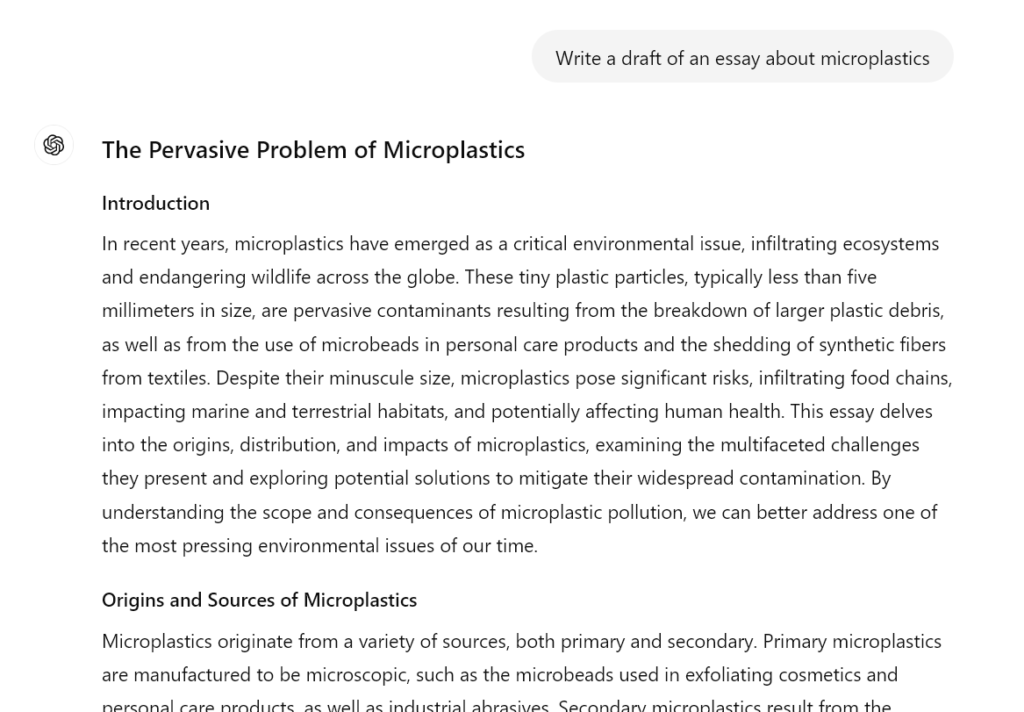
- Made-up facts: because they generate plausible text, they can invent figures, quotes, sources and even court cases. These errors are often called hallucinations.
- Out-of-date knowledge: unless connected to search, they know only what was in their training data.
- Hidden bias: they can repeat stereotypes and gaps found in the text they learned from.
- Overconfidence: they rarely signal uncertainty the way a careful human expert would.
- Privacy: anything you type may be stored by the service, depending on its settings and terms.
Example: ask a chatbot for statistics with sources and it may give real-looking citations that do not exist. Always open the link or find the original document before using a number.
How to use them responsibly
- Treat output as a draft, not a final answer.
- Check facts, figures and quotations against reliable sources, especially for health, legal or financial questions.
- Do not paste sensitive information such as passwords, customer data or confidential documents into public tools.
- Say when you used AI if your school, employer or publication requires it.
- Read news at the source. Reuters Institute research found that chatbots are a growing route to news; checking the original article matters, as our columnist argues in In Praise of Reading Past the Headline.
How Artificial Intelligence Is Changing Everyday Work
The bigger picture
These systems are improving quickly, and many are now linked to search engines and other tools that reduce some weaknesses. They are also changing how people work, as we explore in how AI is changing everyday work. The habit of checking important claims remains as valuable as ever.
Common myths
| Myth | Reality |
|---|---|
| “It searches the internet for every answer” | Only if the product is connected to search; otherwise it relies on what it learned in training |
| “If it gives a source, the source is real” | Models can invent convincing citations; always check |
| “It understands like a person” | It is very good at patterns in language, but it does not have experiences or intentions |
| “It is always neutral” | It can reflect biases in its training data and in the choices of its developers |
Frequently asked questions
Is it safe to use AI chatbots for homework or work?
It can be helpful for drafting and explaining, as long as you follow your school’s or employer’s rules, check facts and do not share confidential information.
Why do chatbots give different answers to the same question?
They generate text with some randomness, choosing among several likely continuations. Small changes in wording can also change the answer.
Can AI chatbots replace search engines?
For some questions they are faster, but they can be wrong without warning. For facts that matter, check a reliable original source.