In this article
- How intervention works
- 1. The Plaza Accord, 1985: a coordinated success
- 2. Black Wednesday, 1992: fighting the fundamentals
- 3. The Swiss franc floor, 2011 to 2015: a peg that snapped
- 4. China, 2015: a devaluation and a costly defence
- 5. Japan, 2022 to 2026: buying time
- The pattern across all five
- What this means if you follow currency markets
- Frequently asked questions
Most of the time, exchange rates are set by millions of trades between banks, companies and investors. Occasionally a government decides the market has gone too far and steps in with its own money, sometimes tens of billions of dollars in a single day. The results range from a lasting shift in the world’s currencies to a costly defeat within hours.
The difference usually comes down to one question: is the intervention pushing in the same direction as the economic fundamentals, or against them? Five well-documented cases show the pattern.
Key facts
- ¥15.4 trillion (about US$100 billion): what Japan reported spending between 30 July and 26 August 2026, the largest total for any month-long period in its records back to 1991.
- £3.3 billion: the UK Treasury’s later estimate of what defending the pound cost on Black Wednesday in 1992.
- About 30 percent: how far the Swiss franc jumped within minutes when Switzerland dropped its euro floor in January 2015.
- Asymmetry: a central bank can create unlimited amounts of its own currency to weaken it, but to strengthen it, it must spend foreign reserves, which can run out.
How intervention works
To strengthen its currency, a central bank or finance ministry sells foreign currency from its reserves, usually US dollars, and buys its own currency. To weaken its currency, it does the opposite: it creates its own currency and uses it to buy foreign assets. Governments also use “verbal intervention”, warning that they are watching the market closely, which can move prices on its own.
Interventions are strongest when several countries act together, and when interest-rate policy points the same way. When they fight both the market and their own interest rates, they rarely last.
1. The Plaza Accord, 1985: a coordinated success
By 1985 the US dollar had risen so far that American exporters were struggling. On 22 September 1985, finance ministers and central bankers of the United States, Japan, West Germany, France and the United Kingdom met at the Plaza Hotel in New York. Their joint statement said that “some further orderly appreciation of the main non-dollar currencies against the dollar is desirable”, and they backed it with coordinated dollar sales.
It worked, partly because the dollar had already started to turn. The yen went from about 240 per dollar before the meeting to about 150 by early 1987. The fall went far enough that in February 1987 the same countries signed the Louvre Accord to try to stop it.
2. Black Wednesday, 1992: fighting the fundamentals
In 1990 the UK joined Europe’s Exchange Rate Mechanism, promising to keep the pound within a band against the Deutsche Mark. By 1992 that was painful: Germany kept interest rates high after reunification while Britain was in recession. Traders, including George Soros’s fund, bet heavily that the pound would fall.
On 16 September 1992 the Bank of England bought pounds in huge amounts and the government raised interest rates from 10 to 12 percent, then announced a further rise to 15 percent, all in one day. None of it worked. That evening the UK suspended its membership and let the pound fall. A Treasury minute released in 2005 put the cost at about £3.3 billion.
3. The Swiss franc floor, 2011 to 2015: a peg that snapped
During the euro crisis, investors piled into the Swiss franc as a safe haven, pushing it so high that Swiss exporters were at risk. On 6 September 2011 the Swiss National Bank set a minimum rate of 1.20 francs per euro and promised to buy foreign currency in unlimited amounts to defend it.
For more than three years it held. Then, on 15 January 2015, with the euro weakening further and the cost of the policy growing, the bank abandoned the minimum exchange rate without warning and cut its deposit rate to minus 0.75 percent. The franc jumped by as much as 30 percent within minutes. Several currency brokers suffered large losses as clients’ leveraged positions went deeply negative, and some firms failed.
4. China, 2015: a devaluation and a costly defence
On 11 August 2015 the People’s Bank of China lowered the yuan’s daily reference rate by about 1.9 percent, its largest one-day change in two decades, and said it would let market prices play a bigger role. Markets took it as the start of a larger devaluation, and money flowed out of China.
To stop the slide becoming a rout, the central bank then sold dollars on a large scale. China’s foreign exchange reserves, close to US$4 trillion in mid-2014, fell to around US$3 trillion by early 2017. The episode shows that intervention can run in both directions, sometimes within weeks.
5. Japan, 2022 to 2026: buying time
Japan has intervened more often than any other large economy in recent years, and its Ministry of Finance publishes every operation. The yen weakened because Japanese interest rates stayed far below those in the United States, making dollars more attractive to hold.
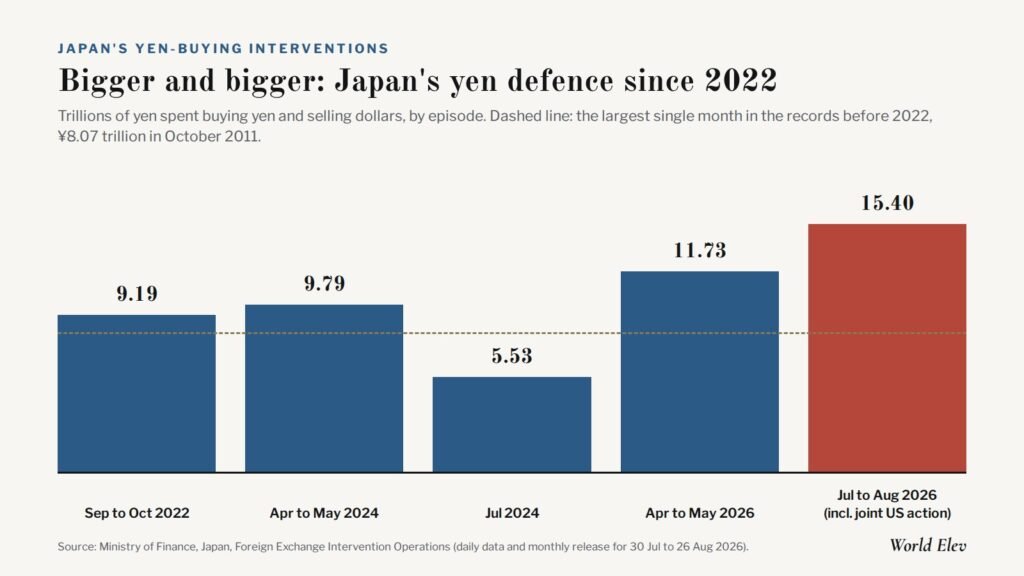
| Episode | Yen bought | What happened |
|---|---|---|
| 22 Sept to 24 Oct 2022 | ¥9.19 trillion | First yen-buying since 1998, near 146 and then 152 per dollar |
| 29 Apr to 1 May 2024 | ¥9.79 trillion | After the yen passed 160 per dollar |
| 11 to 12 July 2024 | ¥5.53 trillion | Further support near 160 |
| 30 Apr to 6 May 2026 | ¥11.73 trillion | Three operations in a week |
| 30 July to 26 Aug 2026 | ¥15.40 trillion | Includes the first joint yen-buying with the US since 1998 |
The largest action came on 31 July 2026, when Japan bought yen in coordination with the US Treasury, the first joint yen-buying operation by the two countries since 1998. The yen, which had weakened to nearly 164 per dollar, strengthened to around 155, but within about ten days it had slipped back to around 159. Each Japanese intervention has bought time without changing the interest-rate gap that drives the yen lower.
The pattern across all five
| Case | Direction | With the fundamentals? | Outcome |
|---|---|---|---|
| Plaza Accord, 1985 | Weaken the dollar | Yes, and coordinated | Lasting shift |
| Black Wednesday, 1992 | Strengthen the pound | No | Defeat within a day |
| Swiss floor, 2011 to 2015 | Weaken the franc | Partly | Held three years, then broke suddenly |
| China, 2015 | Steer, then support the yuan | Partly | Slide slowed at a cost of about $1 trillion in reserves |
| Japan, 2022 to 2026 | Strengthen the yen | No (rate gap persists) | Short-lived gains each time |
What this means if you follow currency markets
- Watch the warnings. Officials usually escalate their language before acting. In Japan, phrases about watching moves “with a sense of urgency” have often come before intervention.
- Expect gaps. Interventions and broken pegs can move prices faster than stop-loss orders can be filled, as the Swiss franc showed.
- Look at interest rates. An intervention that fights the interest-rate gap tends to fade. One backed by policy changes tends to last.
- Mind your leverage. A move that is normal for an index can wipe out a heavily leveraged currency position.
Important: This article explains historical events. It is not trading or investment advice. Currency trading with leverage carries a high risk of loss.
Frequently asked questions
Who actually carries out an intervention?
It depends on the country. In Japan, the Ministry of Finance decides and the Bank of Japan executes the trades. In Switzerland, the central bank decides and acts. In the UK, the Bank of England trades using reserves held by the Treasury, and in the United States the Treasury and the Federal Reserve share the responsibility.
Can a central bank always win?
Only when it is weakening its own currency, because it can create unlimited amounts of it. Defending a weak currency requires foreign reserves, which are finite, and markets know it.
How do we know when Japan has intervened?
Japan’s Ministry of Finance publishes monthly totals shortly after each month’s reporting period and daily details every quarter. Officials also sometimes confirm operations on the day.
For background on how interest rates shape currencies and borrowing costs, read what interest rate decisions mean for your household, or browse the Forex section.
Sources
- G5 Plaza Accord announcement, 22 September 1985 (University of Toronto G7 Research Group)
- HM Treasury minute: the cost of Black Wednesday reconsidered (Margaret Thatcher Foundation archive)
- Swiss National Bank: monetary policy after the discontinuation of the minimum exchange rate (2015)
- Ministry of Finance, Japan: foreign exchange intervention operations
- Ministry of Finance, Japan: statement on the joint intervention, 3 August 2026