In this article
Why do some earthquakes cause more damage than others? Because magnitude measures the energy released at the source, not what happens where people live. How deep the quake is, how far it is from a city, what the ground is made of and how buildings were constructed often matter more. In 2010 a magnitude 7.0 earthquake in Haiti killed vastly more people than a magnitude 8.8 in Chile, which released about 500 times more energy.
Key facts
- Each magnitude step means 10 times the ground motion and about 32 times the energy, according to the USGS.
- Haiti 2010 (M7.0): official estimate 316,000 deaths; Chile 2010 (M8.8): at least 523.
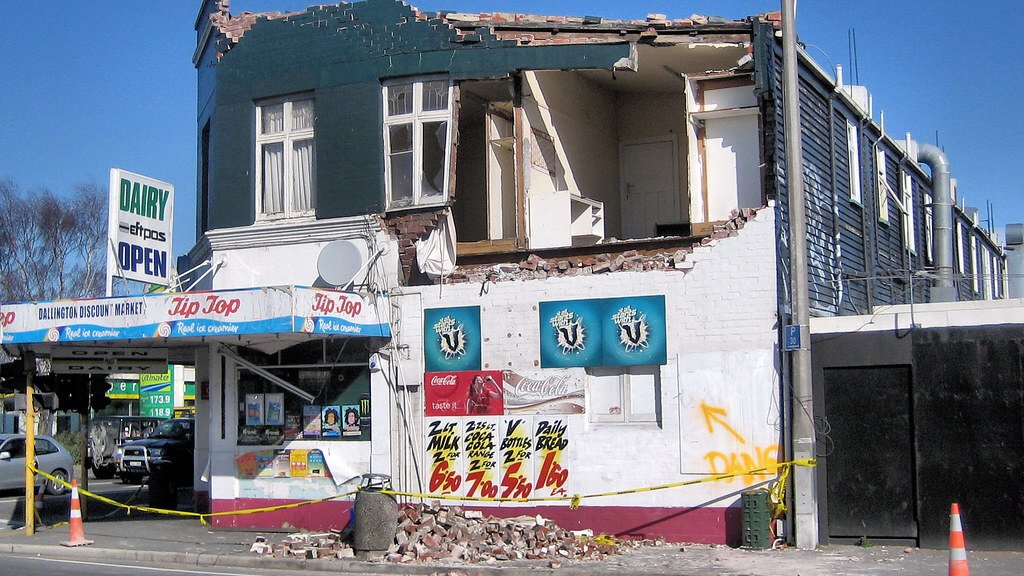
- Shallow and close is worst: Christchurch 2011 (M6.1, 5.9 km deep) killed at least 181 people; the larger Darfield quake months earlier killed none.
- Deep quakes do less harm: a M8.2 in Bolivia in 1994 was 631 km down.
Earthquake magnitude calculator
Compare two earthquakes. The defaults compare Haiti 2010 (M7.0) with Chile 2010 (M8.8): the larger quake produced about 63 times the ground motion and about 501 times the energy.
Compare two earthquakes: how much stronger the shaking and how much more energy one releases than the other.
Uses the USGS rules of thumb: each whole magnitude step is 10 times the amplitude of ground motion on a seismogram and about 32 times (10 to the power 1.5) the energy. Damage depends on much more than magnitude: depth, distance, soil and buildings.
Want to come back to it later? Bookmark our standalone earthquake magnitude calculator, or browse all our free calculators.
Magnitude vs intensity
Magnitude is a single number for each earthquake that describes its size at the source. The USGS explains that one whole unit of magnitude is 10 times the amplitude on a seismogram and about 32 times the energy (10 to the power 1.5). Intensity is different: it describes how strongly the shaking was felt at a particular place, so one quake has many intensity values, highest near the epicentre and lowest far away. Damage tracks intensity, not magnitude. If you want the physics of energy units, see our explainer on watts, joules and power.
7 earthquakes compared
| Earthquake | Magnitude | Depth | Deaths (USGS record) |
|---|---|---|---|
| Haiti, 12 Jan 2010 | 7.0 | 13 km | 316,000 official estimate; other estimates under 100,000 |
| Maule, Chile, 27 Feb 2010 | 8.8 | 22.9 km | At least 523, plus 24 missing |
| Darfield, New Zealand, 4 Sep 2010 | 7.0 | 12 km | None; two seriously injured |
| Christchurch, New Zealand, 22 Feb 2011 | 6.1 | 5.9 km | At least 181 |
| Pazarcik, Turkey, 6 Feb 2023 | 7.8 | 10 km | At least 50,399 in Turkey |
| Michoacan, Mexico, 19 Sep 1985 | 8.0 | 27.9 km | At least 9,500; some sources up to 35,000 |
| Northern Bolivia, 9 Jun 1994 | 8.2 | 631 km | Unconfirmed reports of 5 in Peru |
Why do some earthquakes cause more damage? Five factors
1. Depth
Shallow earthquakes release their energy close to the surface, so shaking arrives strong. The 1994 Bolivia quake was magnitude 8.2, one of the largest deep earthquakes recorded, but at 631 km down it caused only light damage. Christchurch’s 2011 quake was much smaller at 6.1, but just 5.9 km deep and right under the city.
2. Distance to people
Shaking fades with distance. The Darfield quake of September 2010 was magnitude 7.0, about 22 times the energy of the Christchurch quake five months later, but it struck farther from the city centre at 4:35 am local time, when few people were in shops and offices. No one died. The smaller February 2011 quake hit beneath the city at lunchtime.
3. Soil
Soft ground amplifies shaking, and waterlogged sand can turn to liquid, a process called liquefaction. The USGS records liquefaction in both New Zealand quakes. In 1985, the Michoacan earthquake struck the Pacific coast, but some of the worst damage was in Mexico City, far inland, where buildings sit on soft former lake-bed sediments.
4. Buildings
This is usually the biggest factor in deaths. Chile has strict building codes, learned from earlier quakes, so its 2010 megaquake killed hundreds rather than tens of thousands, even though the USGS records 370,000 houses damaged or destroyed and $30 billion in losses. Haiti had few enforced codes and many heavy concrete buildings, so a much smaller quake was catastrophic.
5. Secondary hazards
Tsunamis, landslides and fires can add to the toll. Chile’s figures include tsunami victims, and the USGS notes a local tsunami in Haiti too. For another natural hazard with knock-on effects, see our report on what a severe solar storm would do on Earth.
Worked example: Haiti vs Chile
Magnitude 8.8 minus 7.0 is 1.8 steps. Ground motion is 10 to the power 1.8, about 63 times larger. Energy is 10 to the power 2.7 (1.5 times 1.8), about 501 times larger. Yet Haiti’s official death toll was hundreds of times higher than Chile’s. The difference was not the earthquake; it was depth, distance to the capital and, above all, the buildings.
Safety note: This article is for general education. Follow your local emergency agency’s advice on earthquake preparedness.
Frequently asked questions
Why do some earthquakes cause more damage than others?
Because damage depends on depth, distance from people, soil type, building quality and secondary hazards such as tsunamis, not just magnitude.
Why do shallow earthquakes cause more damage?
Their energy is released close to the surface, so strong shaking reaches buildings before it fades. Deep quakes lose much of their energy on the way up.
What is the difference between earthquake magnitude and intensity?
Magnitude is one number for the quake’s size at the source. Intensity describes the shaking felt at a particular place and varies with location.
Do deeper earthquakes cause more damage?
Usually less. A magnitude 8.2 quake 631 km below Bolivia in 1994 caused light damage over a wide area.
How much stronger is a magnitude 8 than a magnitude 7?
About 10 times the ground motion and about 32 times the energy, according to the USGS.
Read more in our Earth and Climate section.
Sources
- USGS: How much bigger? Magnitude and energy comparison
- USGS: M7.0 Haiti earthquake, 12 January 2010
- USGS: M8.8 Maule, Chile earthquake, 27 February 2010
- USGS: M6.1 Christchurch, New Zealand, 21 February 2011 UTC
- USGS: M7.8 Pazarcik, Turkey, 6 February 2023
- USGS: M8.0 Michoacan, Mexico, 19 September 1985
- USGS: M8.2 Northern Bolivia, 9 June 1994