
In this article
Many history books begin philosophy with Thales of Miletus, a Greek thinker who lived from about 620 to about 546 BCE. As the Internet Encyclopedia of Philosophy explains, Thales is often called the first philosopher because he tried to explain the world through nature rather than myths about gods.
But people in Egypt and Mesopotamia had been writing about how to live, what justice is and why people suffer for well over a thousand years before him. Were they doing philosophy? It depends on how you define the word. Here is what they wrote, and why it matters.
Key facts
- Thales lived about 620 to 546 BCE and is often called the first Greek philosopher.
- The Instruction of Ptah-Hotep, an Egyptian guide to good conduct, is dated to about 2450 BCE.
- Ma’at was the Egyptian idea of truth, justice, harmony and balance.
- The Dialogue of Pessimism, a Babylonian poem from about 1000 BCE, asks whether any action is worth doing.
What counts as philosophy?
The word philosophy comes from Greek and means “love of wisdom”. Greek philosophers did something new: they argued openly, gave reasons and expected others to challenge them. Most Egyptian and Babylonian texts work differently. They are usually advice from a father, a teacher or a king, or poems shaped as conversations.
So there are two fair views. If philosophy means formal argument, it began with the Greeks. If it means thinking carefully about how to live and what life means, it is much older.
Egypt: living by Ma’at
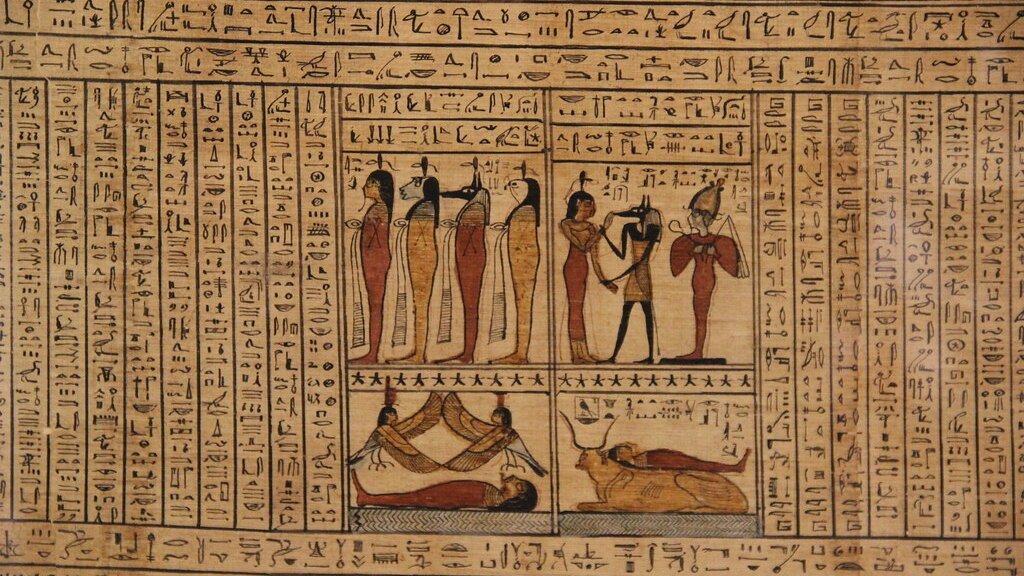
At the centre of Egyptian thought was Ma’at, both a goddess and an idea. World History Encyclopedia describes Ma’at as the concept of truth, justice, harmony and balance, and notes that it was already central in the Old Kingdom. A good life meant living in harmony with Ma’at. Kings claimed to uphold it, and the dead were believed to be judged by it.
This is close to what philosophers now call ethics: the study of right and wrong. The Egyptians did not just list rules. They tied good behaviour to a bigger picture of order in the universe.
The Instruction of Ptah-Hotep
One of the oldest surviving works of advice is the Instruction of Ptah-Hotep, dated to about 2450 BCE, in Egypt’s Fifth Dynasty. It is written as the advice of an older official to his son. Its themes would fit easily in a modern self-help book: be humble, listen well, do not be greedy, and treat others fairly.
One famous idea in the text is that wisdom can be found anywhere, even among ordinary working people. That is a striking claim for a royal official to make more than 4,000 years ago.
Mesopotamia: questioning the gods
Babylonian writers, working in the Akkadian language on clay tablets, went further in one direction: they asked uncomfortable questions.
The Babylonian Theodicy
A theodicy is an attempt to explain why a just god allows suffering. The Babylonian Theodicy is a poem in which a suffering man debates a friend. The sufferer points out that bad people prosper while good people struggle; the friend defends the gods. Scholars usually date it to somewhere between about 1600 and 900 BCE and often compare it with the biblical Book of Job.
The Dialogue of Pessimism
The Dialogue of Pessimism, from about 1000 BCE, is a conversation between a master and his slave. In each exchange, the master proposes an action, such as going to the palace or falling in love. The slave gives reasons for it. Then the master changes his mind, and the slave gives equally good reasons against it.
Is it a bleak poem about the meaninglessness of life, or a joke? World History Encyclopedia notes that it was copied as part of the curriculum of scribal schools, and that scholars still debate whether students took it seriously or as comedy. Either way, it shows people questioning the purpose of their actions long before Socrates.
| Text | Place | Approximate date | Big question |
|---|---|---|---|
| Instruction of Ptah-Hotep | Egypt | about 2450 BCE | How should a good person behave? |
| Ideas of Ma’at | Egypt | Old Kingdom onward | What keeps society and the world in order? |
| Babylonian Theodicy | Mesopotamia | about 1600 to 900 BCE | Why do good people suffer? |
| Dialogue of Pessimism | Mesopotamia | about 1000 BCE | Is any action worth doing? |
| Thales of Miletus | Greek Ionia | about 620 to 546 BCE | What is the world made of? |
Did the Greeks learn from them?
Probably in part. Thales lived in Miletus, a trading city on the coast of what is now Turkey, with links to Egypt and the Near East. The Internet Encyclopedia of Philosophy notes ancient reports that Thales visited Egypt. But the exact influence is hard to prove, because so few records survive.
What is clear is that the Greeks did not invent deep thinking from nothing. They added something important, the habit of open argument, to questions that people had already been asking for centuries.
If ancient writing systems interest you, see why no one can read the Indus script yet, or how the Maya predicted eclipses without telescopes.
Frequently asked questions
Who was the first philosopher?
In the Western tradition, Thales of Miletus is usually named first. But Egyptian and Babylonian texts asked about ethics, justice and suffering much earlier.
What is Ma’at?
An ancient Egyptian goddess and idea representing truth, justice, harmony and balance. Living by Ma’at was seen as living well.
What is the oldest philosophy book?
There is no single answer. The Instruction of Ptah-Hotep, dated to about 2450 BCE, is often named among the oldest surviving works of moral advice.
What is the Dialogue of Pessimism about?
A master proposes various actions and his slave argues both for and against each one, suggesting that no choice is clearly better. Scholars debate whether it is serious or satire.
Browse more in our Philosophy section.