In this article
Long before telescopes, Maya astronomers in Mexico and Central America could tell when a solar eclipse might happen. They did it with careful counting, written records kept over generations, and a clever table that fits on eight pages of a book.
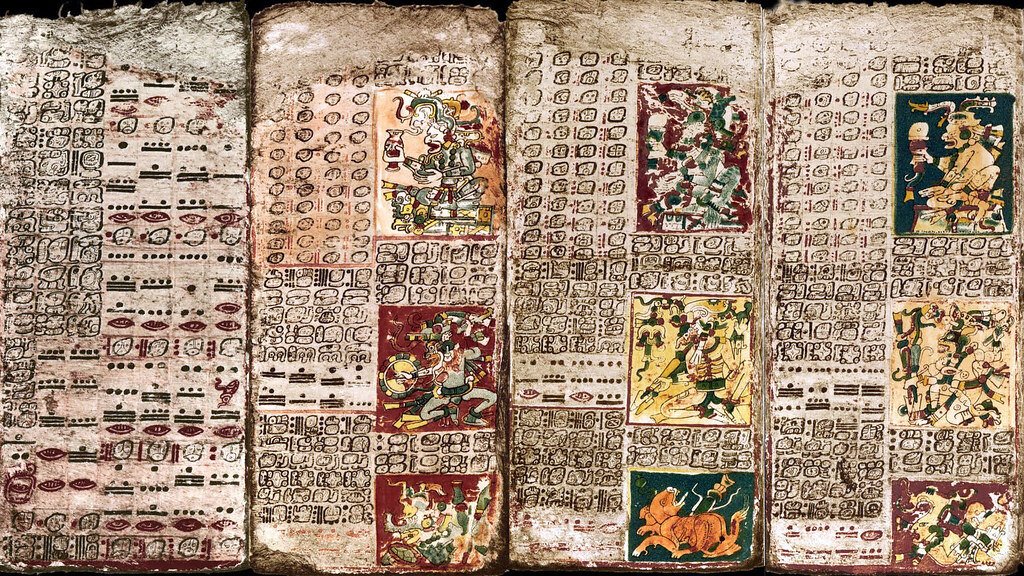
That book is the Dresden Codex, and a study published in October 2025 in Science Advances shows how its eclipse table was built and how the Maya kept it accurate for hundreds of years.
Key facts
- The Dresden Codex is a Maya book from about the 12th century CE, now held in Dresden, Germany.
- 405 lunar months: the length of its eclipse table, equal to 11,960 days.
- 46 × 260 days: 11,960 days is also exactly 46 cycles of the Maya 260-day calendar.
- 350 to 1150 CE: the period over which the study found the system could predict solar eclipses seen in the Maya region.
What causes an eclipse, in one paragraph
A solar eclipse happens when the Moon passes between the Sun and Earth. That can only happen at new moon. But it does not happen at every new moon, because the Moon’s path is tilted compared with the Sun’s path across the sky. An eclipse is only possible when a new moon falls close to one of the two points where those paths cross. That happens in two “eclipse seasons” a year, roughly six months apart.
So if you can count new moons accurately, and you know roughly when the eclipse seasons fall, you can say when an eclipse is possible. That is exactly what the Maya table does.
How the table works
The table is a list of “stations”. Each station is a new moon when an eclipse could happen. Most stations are six lunar months apart, about 177 days, which matches the gap between eclipse seasons. Every so often the gap is five months instead, which keeps the table in step with the seasons.
The full table runs for 405 lunar months. The Maya chose that length for a reason. 405 lunar months is 11,960 days, which is also exactly 46 rounds of their 260-day ritual calendar. That made it easy to link each eclipse date to a day in the calendar they used for ceremonies and divination.
| Cycle | Length | Why it matters |
|---|---|---|
| Lunar month | about 29.53 days | New moon to new moon |
| Eclipse table | 405 lunar months = 11,960 days | Matches 46 rounds of the 260-day calendar |
| Saros | 223 lunar months, about 18 years | Eclipses repeat in a similar pattern |
| Inex | 358 lunar months, about 29 years | A longer repeat cycle of eclipses |
The clever part: fixing the drift
No table of whole days can match the Moon perfectly. Over time, small errors add up, and predictions slowly drift away from real eclipses. The 2025 study, by John Justeson and Justin Lowry, shows how the Maya solved this.
Instead of starting the table again from the beginning when it ran out, they restarted it early, at fixed points. Sometimes they reset after 358 lunar months, and sometimes after 223. According to the study, as reported by Archaeology Magazine, using four resets at 358 months for every one at 223 kept the table in step with the real Moon for centuries.
Those two numbers are not random. Modern astronomers know 223 lunar months as the saros cycle and 358 months as the inex cycle. Both are standard tools for predicting eclipses today, as NASA explains. The Maya found the same patterns by watching and counting.
From a moon calendar to an eclipse calendar
Earlier scholars believed the 405-month table was designed only to predict eclipses. The new study suggests a different story. The table seems to have started as a lunar calendar, a way of tracking months. Later, Maya astronomers adapted it into an eclipse warning system by marking the new moons when eclipses could happen.
The researchers compared the table with 145 solar eclipses in NASA’s records. They concluded that the system could predict the solar eclipses visible in the Maya region between 350 and 1150 CE. They also said the method would still be capable of predicting eclipses over Mexico today.
Why this matters
- No instruments needed. The Maya did this with naked-eye observation, careful records and arithmetic, kept over many generations.
- It shows long-term planning. A table that works for centuries needs records that outlast any single person.
- It links science and belief. For the Maya, eclipses had religious meaning. Predicting them was part of ceremony as well as astronomy.
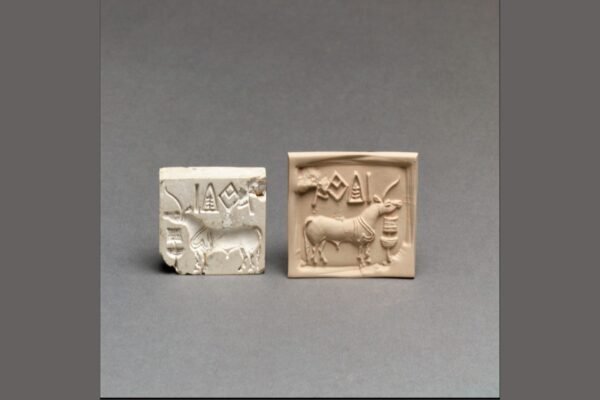
Some ancient writing systems are still a mystery. Maya writing has been largely deciphered, which is why scholars can study this table in such detail. Compare it with the Indus script, which no one can yet read.
Frequently asked questions
Did the Maya have telescopes?
No. Telescopes were not invented until the early 1600s in Europe. Maya astronomers relied on naked-eye observation, written records and arithmetic.
Where is the Dresden Codex today?
It is held at the Saxon State and University Library in Dresden, Germany, which is how it got its name. It is one of only a few Maya books that survived the Spanish conquest.
Could the table say exactly where an eclipse would be seen?
No. It marked the new moons when a solar eclipse was possible. Combined with resets and long records, it pointed to the eclipses likely to be visible in the Maya region.
To see how modern astronomers measure time on a much larger scale, read how scientists know the age of the universe, or browse the Ancient World section.