In this article
More than four thousand years ago, people in the cities of the Indus valley pressed small stone seals into clay. Each seal carried an animal and a short line of signs. We have found thousands of them. We still cannot read a single one.
That makes the Indus script the largest body of writing from the ancient world that remains undeciphered. Egyptian hieroglyphs, Babylonian cuneiform and Maya glyphs all gave up their secrets. This one has not, despite a century of effort and, since 2025, a one-million-dollar reward.
Key facts
- About 5,000 inscribed objects have been found since excavations began in the 1920s, mostly small seals and tablets.
- Five or six signs is the typical length of an inscription. The longest known runs to only a few dozen.
- About 400 to 700 distinct signs, depending on which scholar is counting.
- No bilingual text has ever been found, which is the single biggest obstacle.
- US$1 million was offered by the government of Tamil Nadu in January 2025 for a convincing decipherment.
What survives, and where
The Indus, or Harappan, civilization flourished between roughly 2600 and 1900 BCE across what is now Pakistan and north-west India. Its cities, such as Harappa and Mohenjo-daro in Pakistan and Dholavira and Rakhigarhi in India, had planned streets, drains and standard weights.
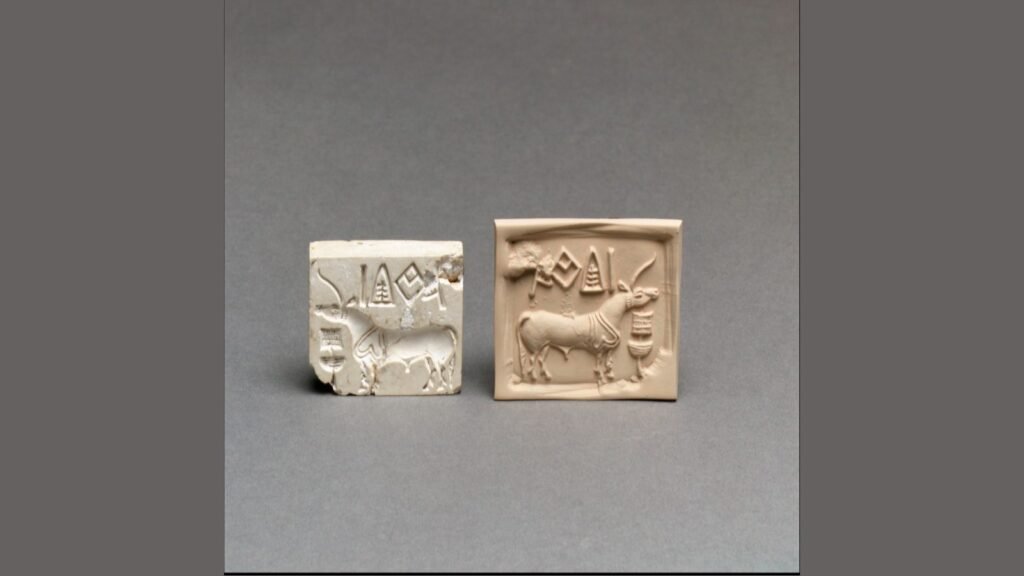
The writing appears mainly on square stamp seals carved from soft stone, like the one above at the Metropolitan Museum of Art. A typical seal shows an animal, most often a one-horned bull, with a short row of signs above it. Signs also appear on clay tablets, pottery, copper plates and bangles. At Dholavira, excavators found ten large signs that once seem to have been set into a board, often called the Dholavira signboard.
Most scholars agree the script was usually written from right to left. The clue is simple: on many seals, the signs on the left are squeezed together, as if the carver was running out of space at the end of the line.
Why it is so hard: three missing ingredients
Every successful decipherment in history has had at least one of three things. The Indus script has none of them.
1. No bilingual text
Egyptian hieroglyphs were cracked with the help of the Rosetta Stone, which carries the same decree in hieroglyphs and in Greek. Cuneiform was unlocked through the Behistun inscription in Iran, written in three languages. No Indus inscription with a translation in a known script has ever been found.
This is surprising, because the Indus people traded with Mesopotamia, which kept detailed written records. Indus seals have turned up in Mesopotamian and Iranian cities, and Mesopotamian texts refer to a distant land called Meluhha, which most historians identify with the Indus region. One Akkadian cylinder seal, now in the Louvre, even belonged to a man described as an interpreter of the Meluhhan language. A bilingual record may once have existed. It has not yet been found.
2. Texts that are far too short
Code-breakers need repetition and context. The average Indus inscription is about five signs long, roughly the length of a name and a title. Short texts give almost no grammar to work with, and they allow almost any proposed reading to fit.
3. An unknown language
Linear B, a script from Bronze Age Crete and Greece, was deciphered by Michael Ventris in 1952 largely because the language turned out to be an early form of Greek, which scholars already knew. Nobody knows what language the Indus people spoke. Without a candidate language, even a correct guess about a sign’s sound cannot be confirmed.
| Script | Bilingual text? | Known language? | Status |
|---|---|---|---|
| Egyptian hieroglyphs | Yes (Rosetta Stone) | Yes (later Coptic) | Deciphered, 1822 |
| Linear B | No | Yes (early Greek) | Deciphered, 1952 |
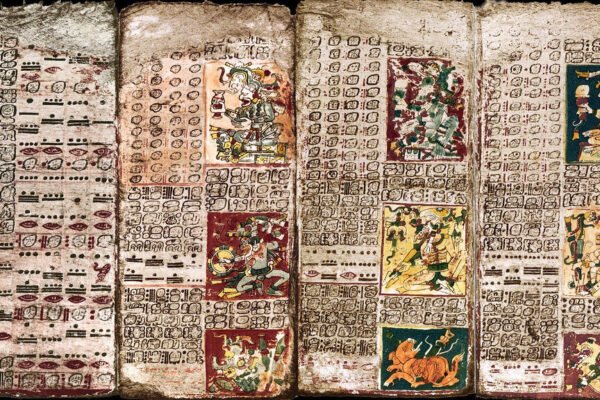
| Maya glyphs | Partial (a Spanish-era list of signs) | Yes (Maya languages still spoken) | Largely deciphered, late 20th century |
| Linear A (Crete) | No | No | Undeciphered |
| Indus script | No | No | Undeciphered |
Is it even writing?
In 2004, Steve Farmer, Richard Sproat and Michael Witzel published a much-discussed paper arguing that the Indus signs were not a full writing system at all but a set of symbols, like religious or clan emblems. They pointed to the very short texts, the large number of signs that appear only once, and the lack of the repetition patterns expected in language.
Others pushed back. In 2009, a team led by Rajesh Rao published a statistical study in the journal Science showing that the order of Indus signs follows patterns similar to those of known languages, and unlike random or purely decorative symbol systems. Critics replied that such statistics cannot prove a system is linguistic. The debate is unresolved, but most specialists today treat the script as writing of some kind.
The main theories about the language
- Dravidian. The most widely supported idea, linked to scholars such as Asko Parpola and Iravatham Mahadevan. Dravidian languages, including Tamil, Telugu, Kannada and Malayalam, are spoken mainly in southern India today, and Brahui, a Dravidian language, is still spoken in Pakistan.
- Indo-Aryan. The idea that the script records an early form of Sanskrit. It has fewer supporters, because most evidence places the arrival of Indo-Aryan languages in the region after the Indus cities declined.
- A lost language. The Indus people may have spoken a language with no living descendants, which would make decipherment far harder.
The $1 million prize
In January 2025, Tamil Nadu’s chief minister, M. K. Stalin, announced a prize of one million US dollars for anyone who deciphers the script to the satisfaction of experts. The announcement came alongside a study by archaeologists K. Rajan and R. Sivananthan, which compared Indus signs with marks scratched on more than 14,000 pottery fragments from Tamil Nadu and reported that about 60 percent of the signs had close counterparts. Similar-looking marks do not prove a shared language, and the study’s conclusions are debated, but the prize has drawn new attention to the problem.
What would it take to crack it?
- A bilingual find. The best hope is an Indus inscription paired with a translation, perhaps in a Mesopotamian archive or trading post.
- Longer texts. A single inscription of several hundred signs would give researchers grammar to test against.
- More excavation. Large sites such as Rakhigarhi are still being studied, and new finds add to the corpus every few years.
- Better tools. Machine-learning studies can group signs and spot patterns, but they need a testable hypothesis about the language to produce a real reading.
Bottom line: The Indus script is not unread because researchers lack skill. It is unread because the evidence that cracked every other ancient script, a translation, long texts or a known language, has not yet been found.
Frequently asked questions
How old is the Indus script?
The mature script was in use from about 2600 to 1900 BCE. Some marks on earlier pottery, from around 3300 BCE, may be early forerunners.
How many Indus inscriptions are there?
Estimates are around 4,000 to 5,000 inscribed objects, depending on what is counted. Many repeat the same short sequences.
Has anyone claimed to decipher it?
Many people have published decipherments, but none has been accepted by other specialists, because no reading has been confirmed by independent evidence such as a bilingual text.
For more on how scholars reconstruct the distant past, see how scientists worked out the age of the universe and browse our Ancient World section.
Sources
- The Metropolitan Museum of Art: Indus stamp seal, 49.40.1
- Archaeology Magazine: $1 million prize offered to decipher the Indus script (January 2025)
- Rao et al., Entropic evidence for linguistic structure in the Indus script, Science (2009)
- Farmer, Sproat and Witzel, The collapse of the Indus-script thesis (2004)
- Harappa.com: images and research on the Indus civilization