Artificial intelligence, or AI, has quickly become one of the most talked-about technologies in the world. You may have heard about AI through ChatGPT, image generators, self-driving cars, smart assistants, or the recommendations you see on YouTube and Netflix.
But despite how often we hear the term, many people still have a simple question: What exactly is artificial intelligence?
You do not need to be a programmer, computer scientist, or technology expert to understand it. At its simplest, artificial intelligence is about creating computer systems that can perform tasks that normally require some form of human intelligence.
AI can recognize patterns, understand language, identify objects in pictures, make predictions, recommend things, and generate content. It does not mean that a computer has become a human brain. Instead, AI uses data, algorithms, and computing power to produce useful results.
In this beginner’s guide, we will look at what AI means, how it works, the different types of AI, where we use it in everyday life, its benefits and limitations, and what the future may look like.
What Is Artificial Intelligence?
Artificial intelligence is a field of technology focused on building computer systems that can perform tasks associated with human intelligence.
For example, humans can look at a photograph and recognize a person. We can read a sentence and understand its meaning. We can listen to someone’s voice, make decisions, solve problems, and learn from previous experiences.
AI systems are designed to perform some of these abilities using computers.
Consider the keyboard on your smartphone. When you start typing a sentence, your phone may suggest the next word. That suggestion is not random. The system looks at the words you have entered and uses patterns it has learned to predict what you might type next.
Similarly, when an email service automatically moves a suspicious message into your spam folder, AI or related machine-learning techniques may be helping identify patterns associated with unwanted messages.
This is an important point: AI is not just robots or chatbots.
Many AI systems work quietly in the background without us even noticing them.
How Does AI Work?
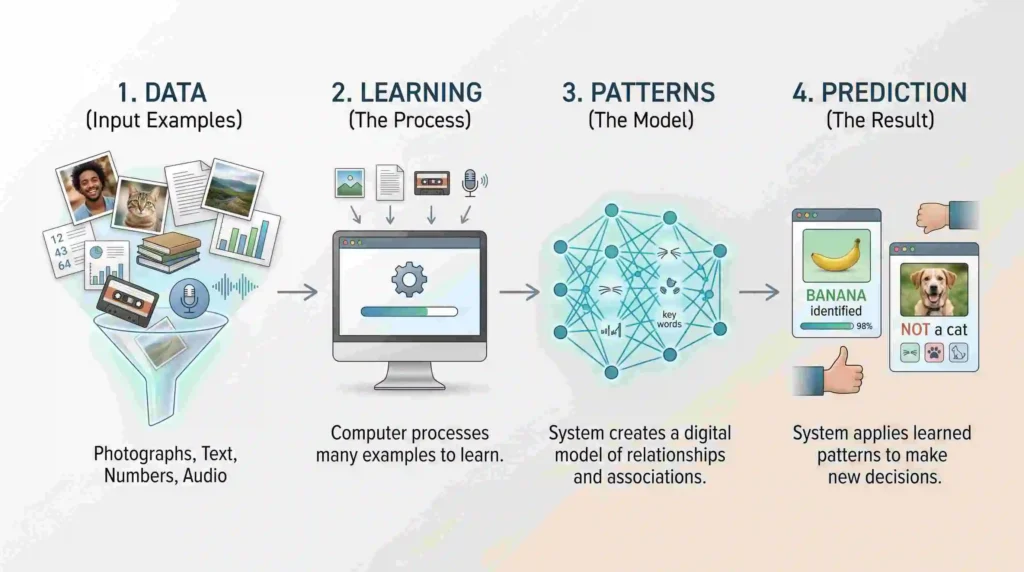
At a basic level, most modern AI systems depend on three important things: data, algorithms, and computing power.
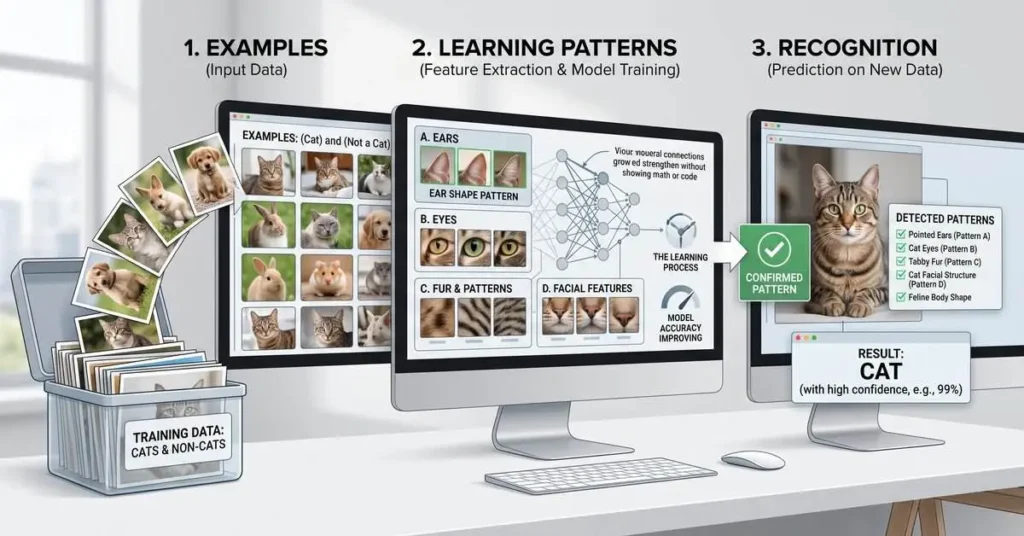
Think of teaching a computer to recognize cats in photographs.
First, the computer needs examples. You might give it thousands or millions of pictures containing cats, along with other pictures that do not contain cats.
These examples are the data.
Next comes the method used to learn from that data. This is where algorithms and machine-learning techniques come into play. The system looks for patterns that help distinguish one type of image from another.
Over time, the system becomes better at identifying the patterns associated with cats.
Once trained, the AI can receive a new photograph it has never seen before and make a prediction about whether a cat is present.
This is different from writing a huge list of instructions such as:
“If the animal has two ears, four legs, whiskers, and a tail, call it a cat.”
Real-world images are far too complicated for humans to describe using a complete list of rules. Machine learning allows computers to discover useful patterns from examples instead.
The quality of the results, however, depends heavily on the quality of the information used to train the system. Poor, incomplete, or biased data can lead to poor results.
What Is Machine Learning?
You will often hear artificial intelligence and machine learning used together. They are related, but they are not exactly the same thing.
Artificial intelligence is the broader field. Machine learning is one of the main approaches used to build AI systems.
Traditional computer programs generally follow instructions written by programmers. If the programmer tells the software exactly what to do, the software follows those instructions.
Machine learning works differently.
Instead of giving the computer every possible rule, developers provide data and a learning method. The system then identifies patterns in the examples.
Imagine showing a child thousands of pictures of different animals. After seeing enough examples, the child may learn to distinguish a dog from a cat.
Machine learning follows a somewhat similar idea, although the underlying process is mathematical rather than human-like.
Machine learning is now used for tasks such as detecting fraud, recommending products, recognizing speech, identifying objects in images, and predicting trends.
What Is Deep Learning?
Deep learning is another term you may encounter when learning about AI.
It is a specialized form of machine learning that uses structures called neural networks. These systems contain multiple layers that process information and can learn complicated patterns.
You do not need to understand the mathematics behind neural networks to understand the basic idea.
Imagine looking at a photograph of a person’s face.
A deep-learning system can gradually process different aspects of the image and identify patterns that help it recognize the face. Similar approaches are used for speech recognition, image analysis, translation, and many other tasks.
Deep learning has played an important role in the rapid development of modern AI because it can work effectively with very large amounts of data and computing power.
The Different Types of AI
People often talk about different “types” of artificial intelligence. One simple way to understand them is to separate AI based on how broad its abilities are.
Narrow AI
The AI systems we use today are generally considered narrow AI, sometimes called weak AI.
Narrow AI is designed to perform a particular task or a limited group of tasks.
For example, an AI system might be very good at recognizing faces but have no ability to drive a car. Another system might be excellent at translating languages but unable to diagnose a medical condition.
A chess-playing AI can become extremely good at chess, but that does not mean it understands how to cook dinner or repair a bicycle.
This is an important distinction because modern AI can appear incredibly intelligent while still having clearly defined limitations.
Chatbots, recommendation systems, spam filters, image-recognition systems, and many voice assistants fall into this broad category.
Artificial General Intelligence
You may also hear about Artificial General Intelligence (AGI).
AGI describes a theoretical type of AI that could understand and perform a wide variety of intellectual tasks at a human-like level.
Instead of being designed for one particular job, an AGI system would theoretically be able to learn different tasks, adapt to unfamiliar situations, and apply knowledge from one area to another.
For example, a true general AI might be able to learn mathematics, write a story, understand a conversation, learn a new game, plan a trip, and solve an unfamiliar problem without needing a separate system for each task.
AGI does not currently exist as a generally accepted reality. It remains an area of research and debate.
What Is Generative AI?
Another term that has become extremely popular is generative AI.
Traditional AI systems often analyze information and provide predictions or classifications. Generative AI can go a step further by creating new content.
For example, generative AI can produce:
- Text
- Images
- Audio
- Video
- Computer code
Chatbots that write answers to questions are examples of generative AI. Image-generation tools can create pictures based on written descriptions.
Large language models, commonly called LLMs, are behind many modern text-based AI applications. They are trained on large amounts of text and learn patterns in human language.
This allows them to generate responses, summarize information, translate text, answer questions, and perform many other language-related tasks.
However, generating a convincing answer does not necessarily mean that an AI system truly understands the world in the same way a person does. AI can also produce incorrect or misleading information, which is why important information should be checked.
Where Is AI Used in Everyday Life?
You probably interact with AI more often than you realize.
Smartphones
Face recognition can help unlock your phone. Voice assistants can respond to spoken questions. Your keyboard can predict words as you type.
Search and Recommendations
When a streaming service recommends a movie or a shopping website suggests a product, AI-based systems may be analyzing patterns in your previous activity and comparing them with other information.
The goal is to predict what you may find useful or interesting.
Navigation
Navigation applications can analyze traffic conditions and suggest routes. AI and related technologies can help estimate travel times and identify changes in traffic patterns.
Spam filters help identify unwanted or suspicious messages. Instead of manually checking every email, automated systems can analyze characteristics of messages and classify them.
Social Media
Social media platforms use algorithms and AI-related technologies to recommend content, detect certain types of harmful material, and personalize what users see.
So, AI is not something that exists only inside research laboratories. It is already part of many ordinary digital services.
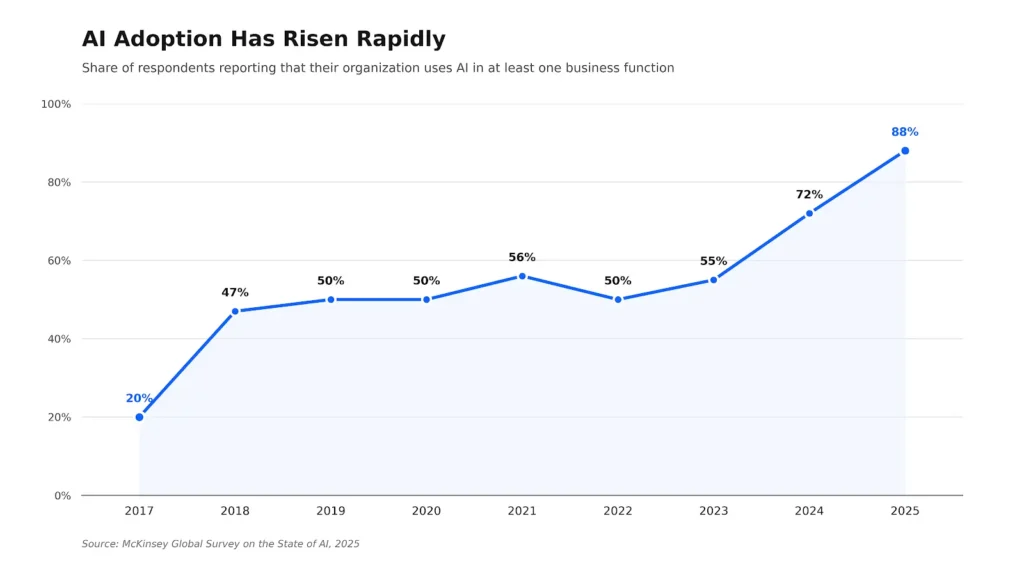
How AI Is Changing Different Industries
AI is also being used far beyond consumer applications.
Healthcare
AI can help medical professionals analyze images, organize information, identify patterns, and support research.
For example, computer systems can assist with analyzing X-rays or other medical images. AI can also be used in drug research and in studying large amounts of medical data.
Importantly, AI does not automatically replace doctors. In many applications, it is better understood as a tool that can help professionals make decisions.
Finance
Banks and financial companies use AI and machine learning for tasks such as detecting unusual transactions, identifying potential fraud, analyzing financial information, and improving customer services.
Education
AI can help create personalized learning experiences. Educational systems can analyze how a student performs and potentially recommend material based on areas where the student needs more practice.
AI-powered tools can also help with tutoring, writing assistance, translation, and administrative tasks.
Transportation
AI is used in navigation, driver-assistance systems, object detection, and research into autonomous vehicles.
A vehicle equipped with AI-based systems can analyze information from cameras and other sensors to identify things such as roads, vehicles, pedestrians, and obstacles.
Cybersecurity
AI is increasingly useful in cybersecurity because security teams often have enormous amounts of information to analyze.
AI-based systems can help identify unusual behavior, detect suspicious activity, examine network traffic, and prioritize potential security threats.
This can help security professionals respond to problems faster, although attackers can also use AI to create new types of threats.
What Are the Benefits of AI?
One of AI’s biggest advantages is its ability to process large amounts of information quickly.
A person may need hours or days to examine a huge dataset. A computer system can process the same information much faster.
AI can also automate repetitive tasks.
For example, instead of having employees manually sort thousands of similar documents, an AI system might classify them automatically. This can give people more time to focus on tasks requiring judgment, creativity, communication, or other human skills.
AI can also help identify patterns that may be difficult for humans to notice.
In scientific research, healthcare, finance, manufacturing, and many other fields, finding these patterns can lead to better decisions and new discoveries.
However, these benefits should not be confused with perfection.
AI can be fast without always being correct.
What Are the Risks and Limitations of AI?
AI has enormous potential, but it also has important limitations.
AI Can Make Mistakes
AI systems can provide incorrect answers or predictions. A system may sound confident even when its answer is wrong.
This is especially important when AI is used for healthcare, finance, legal matters, or other areas where mistakes can have serious consequences.
Bias
AI learns from data. If the data contains unfair or unbalanced patterns, an AI system can sometimes reproduce those patterns.
For example, a hiring system trained on biased historical information could make unfair recommendations.
This is why testing, monitoring, and human oversight are important.
Privacy
Many AI applications depend on large amounts of information. This creates questions about what data is collected, how it is stored, who can access it, and how it is used.
People and organizations need to think carefully about privacy when adopting AI systems.
Jobs and Automation
AI can automate some tasks that people currently perform. This may change the nature of certain jobs and, in some cases, reduce the need for particular tasks.
At the same time, technology can create new roles and change existing ones.
The more realistic way to think about AI and employment is not simply “AI will take all jobs.” Instead, AI is likely to change many jobs, with some tasks becoming automated while new responsibilities and skills become more important.
Is AI Actually Intelligent?
This is one of the most interesting questions about AI.
AI can perform tasks that appear intelligent, but that does not necessarily mean it thinks or feels like a human.
A chatbot can write a thoughtful-looking response, but that does not mean it has emotions or personal experiences.
A recommendation system can predict what you might want to watch, but it does not necessarily “know” you in the human sense.
Modern AI is extremely capable in many areas, but it is still important to understand what it can and cannot do.
The word “intelligence” can make AI sound more human than it actually is.
What Does the Future of AI Look Like?
AI is developing quickly, and it is difficult to predict exactly where it will go.
We are likely to see AI become more deeply integrated into software, education, healthcare, business, science, cybersecurity, entertainment, and everyday devices.
AI assistants may become better at helping people complete complicated tasks. Businesses may use AI to automate more workflows. Researchers may use AI to analyze information and accelerate discoveries.
At the same time, questions about privacy, security, misinformation, employment, fairness, and accountability will become increasingly important.
The future of AI will therefore not depend only on how powerful the technology becomes. It will also depend on how responsibly people build and use it.
Final Thoughts
Artificial intelligence may sound like a complicated subject, but the basic idea is easier to understand than it first appears.
AI is technology that enables computers to perform tasks that normally require some form of human intelligence.
It can recognize patterns, understand language, make predictions, analyze information, and generate content. Machine learning is one of the main ways modern AI systems learn from data, while deep learning is a more advanced approach used for many complex tasks.
You are already surrounded by AI. It appears in your phone, search engine, email, entertainment apps, navigation tools, online shopping, and many other services.
At the same time, AI is not magic and it is not perfect. It can make mistakes, reflect bias in its training data, create privacy concerns, and change the way people work.
Understanding both sides is important.
You do not need to become a programmer to understand AI. Start with the basic ideas, learn how it is being used around you, and remember that AI is a tool created by people. Its impact will ultimately depend on the choices people make about how it is designed, deployed, and used.